
How to Store and Dispose of Pet Medications Safely
On this page
- Quick answer
- Why safe storage matters
- Set up secure storage
- Follow labels and temperature directions
- Prevent errors during daily use
- Choose the right disposal option
- Handle sharps and patches separately
- Respond to accidental exposure
- Home medication checklist
- Limitations and important notes
- Frequently asked questions
- Sources and evidence notes
- Next steps
Quick answer
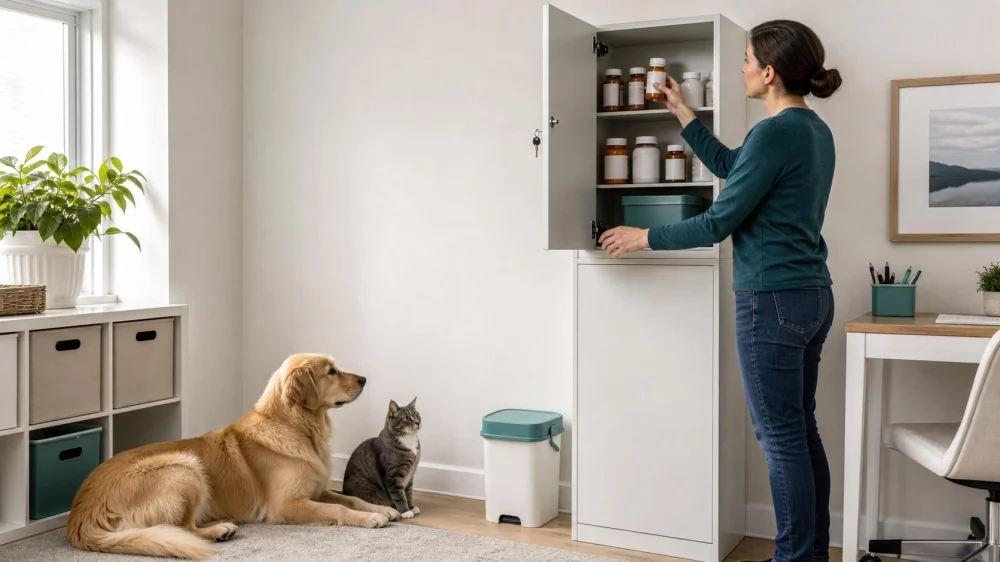
Keep every pet medication in its original, labeled container inside a closed cabinet or lockbox that children and animals cannot reach. Separate animal drugs from human medicines and follow the product's temperature, light, and moisture directions. For unwanted medicine, use a drug take-back option when available; never flush it unless the label or current FDA Flush List specifically directs you to.
Why safe storage matters
Safe medication storage means controlling access while preserving the drug under the conditions stated on its label. A high counter is not necessarily secure: dogs may chew containers, cats and ferrets may climb, and one pet may reach medicine intended for another.
Storage also reduces mix-ups between pets, household members, strengths, and products with similar packaging. It helps keep the prescription label, expiration date, dosing device, and safety information together.
Set up secure storage
- Choose a closed cabinet or lockbox away from food preparation, animal feed, and routine household chemicals.
- Make sure curious pets and children cannot climb to, open, knock down, or chew the container.
- Keep pet drugs physically separate from human medicines and organize different pets' prescriptions in labeled sections.
- Return every bottle, tube, or package immediately after measuring a dose.
- Keep flavored chewable medicine secured like any other drug; a pet may treat the entire package as food.
- Store dosing syringes or cups with the matching medicine without leaving residue where a pet can lick it.
Follow labels and temperature directions
Keep medicines in their original containers with the pharmacy or manufacturer label readable. Do not move tablets into an unlabeled bag, combine old and new prescriptions, or remove desiccants unless the instructions say to.
- Follow the exact storage temperature on the label; “room temperature” and “refrigerate” are not interchangeable.
- Do not freeze a product unless its instructions allow it.
- Protect medication from heat, direct sun, humidity, and water as directed. A hot vehicle and a steamy bathroom are usually poor storage locations.
- Keep liquid suspensions, insulin, compounded products, and opened drops according to their specific instructions.
- Ask the dispensing pharmacy or veterinarian before using a product left outside its required range, exposed to water, or altered in color, odor, texture, or separation.
Prevent errors during daily use
- Read the pet name, drug name, strength, dose, and route before every administration.
- Use the supplied or prescribed measuring device; kitchen spoons are not precise dosing tools.
- Maintain a dose log when several people share care, and mark the dose only after it is given.
- Keep an updated list of prescriptions, nonprescription products, preventives, and supplements.
- Do not use one pet's prescription for another animal or give human medicine without veterinary direction.
- If a dose is missed, vomited, spilled, or possibly repeated, contact the clinic for instructions rather than guessing.
Choose the right disposal option
First choice: Follow disposal instructions on the label or client information sheet. For most expired, unwanted, or unused medicines, FDA recommends a drug take-back location or mail-back option when readily available.
If take-back is unavailable: Check whether the medicine appears on the current FDA Flush List. Only medicines specifically listed for flushing, or whose accompanying instructions direct flushing, should be disposed of that way.
For eligible household-trash disposal: FDA advises mixing the medicine without crushing tablets or capsules with an undesirable material such as used coffee grounds or cat litter, placing it in a sealed container, and putting that container in household trash. Remove or obscure personal information on empty packaging. Keep the mixture inaccessible to pets until collection.
Local pharmacy, solid-waste, and controlled-substance rules can add requirements. A veterinarian or pharmacist can help identify the active ingredient and appropriate option when instructions are unclear.
Handle sharps and patches separately
Needles, lancets, and syringes require an appropriate sharps container and local disposal route; do not place loose sharps in household recycling or trash. Do not recap, bend, or break a used needle unless a healthcare professional's instructions specifically require a technique.
Used medicated patches can retain active drug and may be dangerous if chewed or touched. Follow the product instructions immediately after removal, prevent contact with skin, children, and pets, and verify whether that product is on the FDA Flush List.
Respond to accidental exposure
If a pet chews a bottle, eats medicine, receives the wrong product or dose, or contacts a patch, call a veterinarian, emergency animal hospital, or animal poison control center promptly. Do not induce vomiting or give food, milk, charcoal, or another remedy unless a veterinary professional directs you.
Have the container available and report the product name, strength, possible amount, exposure time, pet's species and weight, symptoms, and other medicines. If a person is exposed, contact the appropriate human poison resource or emergency service.
Home medication checklist
- All containers are original, closed, and clearly labeled.
- Storage is locked or genuinely inaccessible to children and every household pet.
- Pet drugs, human drugs, and different animals' prescriptions are separated.
- Temperature, light, moisture, and refrigeration instructions are being followed.
- A current medication list and dose log are available.
- Expired, discontinued, damaged, or unidentified products are isolated for proper disposal.
- A take-back location and approved sharps route have been identified.
- Veterinary, emergency clinic, and animal poison control contact details are easy to find.
Limitations and important notes
This is general U.S. safety guidance, not a disposal instruction for a particular product. Prescription labels, client information sheets, the current FDA Flush List, and state or local rules take priority. Compounded drugs and specialty products may have unique beyond-use dates and handling directions.
Do not keep leftovers “just in case,” share prescriptions, or continue a discontinued medicine without veterinarian approval. Expiration and beyond-use dates are not interchangeable; ask the dispensing professional when uncertain.
Frequently asked questions
Can I store pet and human medications in the same cabinet?
Physical separation reduces selection errors. If one locked cabinet must be shared, use distinct labeled bins and verify the patient, drug, and strength every time.
Should all pet medicine be refrigerated?
No. Refrigerate only when the label or dispensing professional directs it. Incorrect refrigeration or freezing can damage some products.
Can I put pet pills in a weekly organizer?
Ask the veterinarian or pharmacist first because original packaging may protect against moisture or light and preserves identification. Any approved organizer must remain securely inaccessible to pets and children.
Can I flush expired pet medication?
Not routinely. Prefer take-back for most medicine. Flush only when the label directs it or the active ingredient appears on the current FDA Flush List.
What should I do with an unidentified pill?
Do not administer it. Keep it secured away from pets and children, and ask a veterinarian or pharmacist about identification and disposal.
Sources and evidence notes
The FDA pet medication storage guidance supports original containers, secure access, separation of animal and human drugs, and prompt professional contact after accidental exposure. FDA's unused medicine disposal guidance recommends take-back for most medicines and explains the limited role of the Flush List and household-trash method.
Next steps
Audit every pet medication today. Move it to secure original packaging, photograph the labels for your records, update the dose list, and separate anything expired or unidentified. Then locate a nearby take-back option and confirm local sharps disposal before either is urgently needed.


 Natural AquariumZ3.0 (35 reviews)
 Ellis Crossing Animal Hospital5.0 (44 reviews)
 Dr. Erin Van Dokkenburg0.0 (0 reviews)
 Animal Eye Center4.0 (59 reviews)
 VIP Petcare Vaccination Clinic0.0 (0 reviews)
 Petco4.0 (679 reviews)
 Dog Dental Disease Signs and Prevention — Why 80% of Dogs Over 3 Have Gum Problems
 How to Properly Introduce Cats to New Environments – Tips for a Smooth Transition
 The Role of Mental Stimulation in Pet Health: Why It’s Crucial for Your Pet’s Well-Being
 How to Prevent and Treat Worms in Dogs and Cats
 How to Train Your Pet to Be Comfortable Around Strangers
 The Importance of Regular Vet Check-Ups for Preventive Care