
How to Check Whether a Pet Carrier Fits Correctly
On this page
Quick answer
A correctly fitted pet carrier lets the animal enter without being forced, stand in a natural posture, turn around, and lie down comfortably. It should not be so large that the pet slides across an empty interior during movement. Measure the pet, compare usable internal—not merely external—dimensions, test at home, and verify the exact rules of the veterinarian or transport provider.
This guide is for cat and dog owners in the United States choosing a carrier for routine ground transport or veterinary visits. Airlines, trains, buses, shelters, clinics, and emergency services can have different rules. Always confirm current provider requirements.
What correct carrier fit means
Carrier fit is the relationship between the animal's natural posture and the usable interior space. A label such as “small” or a general weight range is only a starting point. Two pets with the same weight can have different leg length, body length, shoulder height, and head position.
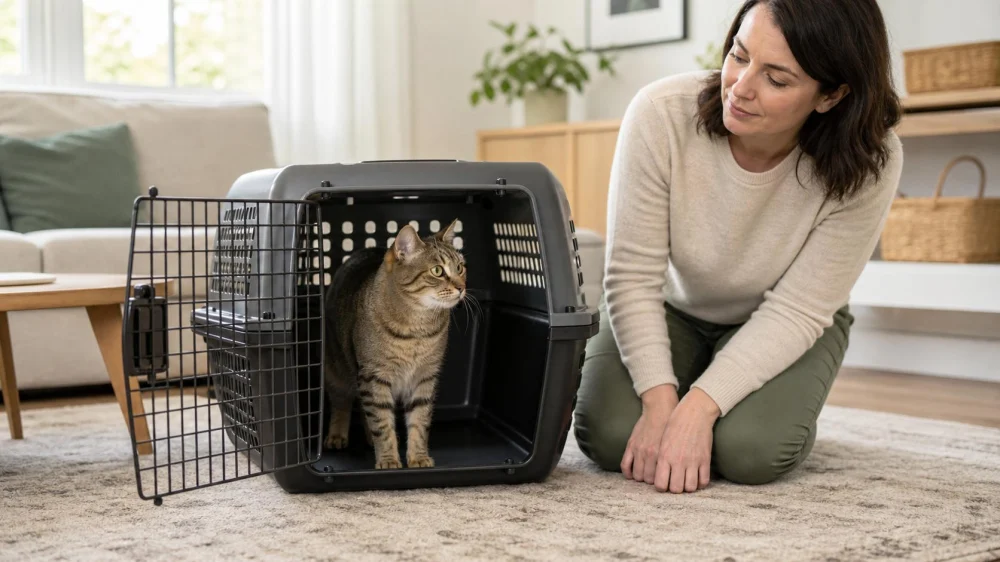
The pet should be able to:
- enter through the opening without scraping or compressing the body;
- stand without the roof forcing the head or back downward;
- turn around without becoming wedged;
- lie in a normal resting position; and
- breathe without fabric, bedding, or a door blocking the face.
Bigger is not automatically safer. Excess space can allow an animal to be thrown against a wall during sudden movement. The correct size offers normal posture plus controlled space, while the carrier itself remains secure.
Measure your pet
Measure when the pet is standing naturally on a level, nonslip surface. Use calm handling and stop if the animal becomes distressed. A soft measuring tape is useful, but a straight object and floor marks can work when the pet will not tolerate a tape.
- Body length: measure from the front of the chest to the rear of the body, excluding a loosely resting tail.
- Standing height: measure from the floor to the highest point of the head or naturally upright ears, whichever needs clearance.
- Width: note the widest comfortable point, often across the shoulders or hips.
- Weight: obtain a current weight when the carrier has a stated load limit.
Compare these measurements with the manufacturer's internal dimensions. Thick padding, curved walls, wheel housings, tapered tops, and storage pockets can reduce usable space. If only external dimensions are listed, request internal measurements or test the carrier in person.
Run a fit test
Place the open carrier on a stable floor and remove unnecessary bedding. Let the pet enter voluntarily when possible. Use treats or a familiar item if appropriate for that animal, but do not push, pull, or close the door during the first inspection.
Watch the pet stand, turn, and settle. Check clearances from several angles. Long fur can hide a head or shoulder touching the shell. In a soft-sided carrier, confirm the top does not collapse onto the animal when the carrier is lifted.
Next, add the thin nonslip or absorbent layer you intend to use and repeat the test. Bedding that is too thick can remove needed headroom or reduce ventilation. Close the door briefly only after the pet is calm, keeping fingers and tails clear of latches.
The carrier is not a good fit if the pet must crouch continuously, cannot turn, is pressed against mesh, becomes tangled in an opening, or slides widely when the carrier moves gently.
Inspect structure and ventilation
Fit depends on more than dimensions. Check that doors and zippers latch securely and cannot be opened by normal pawing or nose pressure. Hard carriers should have intact fasteners and no sharp cracks. Soft carriers need firm seams, reinforced attachment points, and enough structure to maintain breathing space.
Ventilation openings should remain clear when the carrier sits in a vehicle or beside luggage. Do not cover the carrier so completely that airflow is restricted. If a partial visual cover helps a particular pet, use breathable material and monitor temperature and breathing.
Lift the empty carrier by each intended handle, then test it with an appropriate load in a controlled setting. The base should remain level and the closures should not pull apart. Never lift a carrier by a decorative strap or component not designed to bear weight.
Practice calm entry
A well-fitted carrier can still be difficult if it appears only before stressful trips. Leave it open in a familiar room, secure the door so it cannot swing, and allow voluntary exploration. Place a familiar washable mat inside if it does not affect fit.
Build practice in small steps: approach, look inside, place front feet in, enter fully, rest with the door open, tolerate a brief closure, and experience a short lift. Progress at the pet's pace. Forcing an animal can create escape risk and make future handling harder.
Ask a veterinarian or qualified behavior professional for individualized guidance when the pet shows intense fear, aggression, breathing difficulty, or a history of injury during confinement. Do not give sedatives or other medication unless a veterinarian has instructed you for that pet.
Pre-travel checklist
- Recheck fit if the pet has grown, gained or lost weight, changed coat, or developed mobility problems.
- Inspect latches, zippers, seams, ventilation, handles, and the base.
- Add identification as appropriate without creating a chewing or snagging hazard.
- Use a thin, secure, absorbent layer that does not block airflow.
- Confirm current provider size, construction, and documentation rules.
- Secure the carrier in the vehicle according to vehicle and carrier guidance.
- Never place a closed carrier in an unattended vehicle.
Limitations and important notes
- Airline cabin and cargo rules are specific and can change; a carrier that fits the pet may still fail the provider's limits.
- Flat-faced animals, very young or old pets, and animals with heart, breathing, mobility, or anxiety concerns may require veterinary advice.
- Two animals should not share a carrier unless an appropriate professional and the transport provider confirm that the arrangement is suitable.
- A fabric carrier is not automatically crash-tested, escape-resistant, or appropriate for every mode of travel.
- Carrier fit does not replace safe temperature, restraint, handling, and supervision practices.
Frequently asked questions
Should a pet carrier be snug or roomy?
It should permit natural standing, turning, and lying down without large unused space that allows sliding. “Snug” must never mean compressed posture or restricted airflow.
Can I choose a carrier by weight alone?
No. Use weight for the load rating, but use body length, height, width, posture, and usable internal dimensions for fit.
Does thick bedding make a carrier safer?
Not necessarily. Thick bedding can reduce headroom, become hot, bunch under the pet, or block ventilation. Use a stable layer appropriate for the animal and trip.
How often should I check carrier fit?
Check before important travel and whenever the pet's size, weight, coat, posture, or mobility changes. Growing puppies and kittens need more frequent checks.
What if my pet refuses to enter a correctly sized carrier?
Separate fit from behavior. Use gradual, positive familiarization and seek professional help for severe distress. Do not assume a larger carrier will solve fear.
Sources and evidence notes
The checks in this article reflect common veterinary-handling and transport practice: allow natural posture, preserve ventilation, prevent escape, introduce confinement gradually, and verify provider-specific rules. Manufacturer instructions, transport operators, veterinarians, and qualified behavior professionals are the appropriate sources for a particular carrier and animal.
Choose your next step
Measure your pet in a natural standing position, obtain the carrier's internal dimensions, and conduct a calm stand-turn-lie test with the intended liner. If any movement or breathing space is restricted—or if current transport rules are unclear—choose another carrier or obtain professional guidance before the trip.




 Vetco Vaccination Clinic5.0 (2 reviews)
 Annie Biele, DVM0.0 (0 reviews)
 Meijer Pets3.0 (2 reviews)
 Maple Tree Veterinary Hospital and Dog Camp4.0 (433 reviews)
 Lakeside Veterinary Clinic4.0 (78 reviews)
 All Creatures Wise and Wonderful4.0 (22 reviews)
 Top 7 Tips for Pet Training: Build Positive Habits with Confidence
 How to Recognize and Treat Common Pet Poisonings
 How to Calm Pet Anxiety During Thunderstorms and Fireworks
 Best Supplements to Support Healthy Aging in Cats: Keep Your Senior Cat Active
 How to Help Your Pet Recover from Surgery: Post-Op Care Tips
 How to Handle Pet Loss: Grieving Tips for Pet Owners