
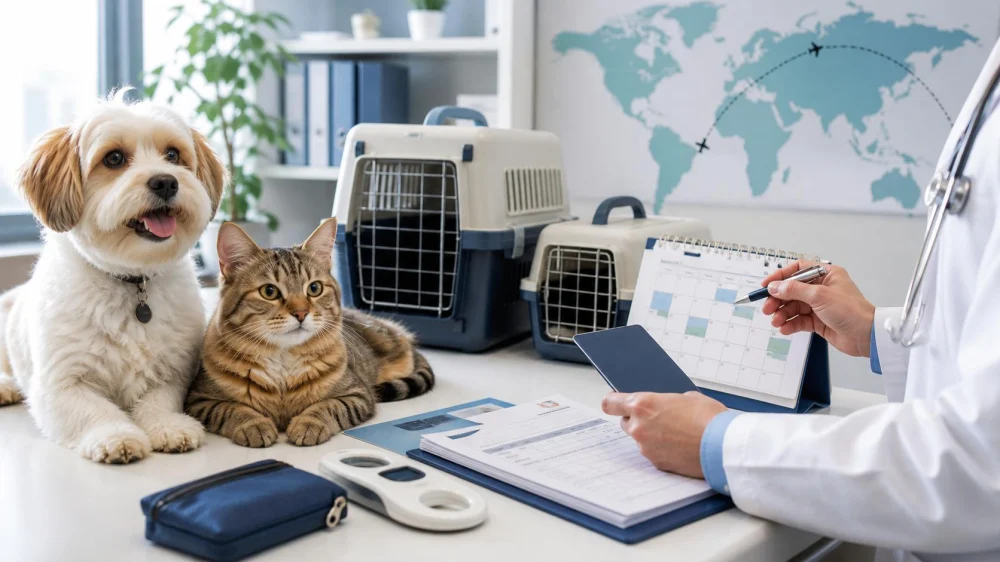
Pet Travel Health Certificates: Build the Timeline First
On this page
Quick answer
Start international pet-travel planning as soon as the destination is known, then work backward from the departure date with a USDA-accredited veterinarian. Confirm the destination, transit-country, airline, and return-entry rules; schedule microchip, vaccination, testing, treatment, examination, certificate, and endorsement steps in their required order; and keep a backup plan. A health certificate can have a short validity window, while an earlier test may require months of lead time.
Why the timeline matters
International pet travel is not a single appointment. It is a sequence of requirements controlled by several organizations, and each step may have its own earliest date, latest date, waiting period, document format, and person authorized to complete it.
A destination may require a microchip to be placed before a rabies vaccination, a laboratory result from an approved facility, a waiting period after the sample, parasite treatment within a narrow period, and a final examination shortly before travel. The health certificate may then need government endorsement. Completing every item but doing one in the wrong order can make the paperwork unacceptable.
Rules can also change. A checklist saved months ago is a planning aid, not proof of the current entry requirements. Recheck the official destination page before major appointments and again shortly before travel.
Identify every rule maker
Collect requirements from each organization involved in the full itinerary:
- Destination government: sets animal-entry requirements and acceptable certificate forms.
- Transit governments: may impose additional rules even when the pet only changes flights.
- USDA APHIS: publishes country-specific guidance for pets leaving the United States and endorses certificates when required.
- Airline or carrier: controls reservations, crate specifications, temperature policies, breed restrictions, and check-in timing.
- U.S. return authorities: set entry rules for bringing the animal back.
- State or local authorities: may have added import, vaccination, or movement requirements.
Write down the exact countries and airports, flight numbers, travel dates, pet species, age, number of animals, ownership purpose, and whether the owner travels with the pet. Those facts can change which certificate and process apply.
Build a reverse calendar
Create one dated schedule rather than a loose task list. Start with the travel date and add every deadline, then add buffer time.
- Record the destination’s accepted arrival window for the health certificate.
- Add the latest permissible examination and certificate-issue date.
- Add time for any required USDA endorsement and document return.
- Place required treatments inside their exact windows.
- Place laboratory sampling and the required waiting period before arrival.
- Confirm vaccination timing, validity, and its relationship to microchip identification.
- Add airline booking, crate preparation, and acclimation practice.
- Schedule an early planning appointment with an accredited veterinarian.
Label each step with who completes it, what evidence it produces, and what later step depends on it. Add a checkpoint for rule changes. Avoid booking a nonrefundable itinerary until the veterinarian has reviewed whether the timeline is realistic.
Prepare the veterinary visit
Ask whether the veterinarian is USDA-accredited and experienced with the destination and species. A regular veterinarian may provide excellent clinical care but may not be authorized to issue a certificate that requires accreditation.
Bring or send:
- the full itinerary, including transit and return;
- the pet’s microchip number and placement date;
- original vaccination certificates and prior laboratory reports;
- owner, consignee, and destination addresses exactly as required;
- airline reservation and cargo details;
- the current official destination instructions and certificate form; and
- any import permit or application number.
Have the clinic scan the microchip and compare every digit with the records. Confirm names, dates, vaccine product details, lot numbers, and signatures before submission. Small transcription errors can create large travel problems.
Check the certificate and endorsement
The destination determines whether a certificate needs USDA endorsement and whether a digital or original paper document is accepted. Follow the current country page and the accredited veterinarian’s instructions.
Before the document leaves the clinic, verify:
- the correct current form and pet category were used;
- all pages and required attachments are included;
- microchip, vaccine, test, treatment, and owner details match the source records;
- dates fall within every required window;
- corrections follow the official method rather than informal alteration; and
- submission, endorsement, payment, and return-delivery plans are documented.
Track the certificate through the veterinarian. USDA notes that pet owners do not submit documents directly to USDA offices and that endorsement may take several business days. Build a backup plan in case the certificate is delayed.
Plan transport and arrival
Health paperwork does not replace transport planning. Confirm the airline’s current reservation, crate, labeling, feeding, documentation, check-in, transfer, and weather rules directly with the carrier. Requirements can differ between cabin, checked-baggage, and cargo travel.
Help the pet become comfortable in the travel carrier well before departure. Keep copies of the itinerary, certificate, vaccination evidence, import permit, veterinarian contacts, and destination instructions together, while carrying originals when required. Do not place the only copy inside checked luggage.
On arrival, follow inspection and customs directions. Keep the pet secured until you are in an appropriate enclosed area. If travel is disrupted, ask the accredited veterinarian whether the certificate remains valid for the revised schedule; do not assume the original dates still work.
Avoid common failure points
- Starting with the flight instead of the rules: a required waiting period may be longer than the time available.
- Checking only the destination: a transit country or return trip may add requirements.
- Using an old form: official certificates and instructions can be revised.
- Missing sequence requirements: a vaccine or test may only count after a particular identification step.
- Assuming every veterinarian is accredited: endorsement may require an accredited issuer.
- Ignoring airline rules: government acceptance does not guarantee carrier acceptance.
- Waiting for the last day: incomplete submissions, shipping, weekends, and holidays can cause delays.
Limitations and important notes
This planning guide is not a certificate, legal determination, or substitute for destination authorities, USDA APHIS, the airline, and an accredited veterinarian. It focuses on pets traveling from the United States to another country; domestic moves, commercial shipments, livestock, wildlife, and animals traveling for sale or research may use different processes.
Do not sedate a pet for travel unless the veterinarian, airline, and applicable rules support a specific plan. Contact a veterinarian promptly if the animal has breathing, heart, temperature-regulation, pregnancy, mobility, or severe anxiety concerns. Animal welfare may require changing the itinerary even when paperwork is valid.
Sources and evidence notes
USDA APHIS states that destination countries set their own requirements, recommends contacting a USDA-accredited veterinarian as soon as travel is considered, and explains that health certificates and endorsement windows can be limited. Its country pages are the starting point for current requirements.
Frequently asked questions
How early should I start?
Start as soon as you know the destination. Some processes take months, while the final certificate may be valid only for a short period.
Can my regular veterinarian issue the certificate?
Ask directly. When USDA endorsement is required, the issuing veterinarian generally must be USDA-accredited and must use the correct process.
Does one certificate cover every country?
Not automatically. Destination, transit, ownership, species, number of pets, and timing can change the required documentation.
Can I submit the certificate to USDA myself?
Follow current APHIS instructions and your accredited veterinarian’s process. USDA currently directs pet owners to work through their veterinarian for submissions and status.
What if my flight changes?
Contact the veterinarian and airline immediately. A date change can move the pet outside a certificate, test, or treatment window.
Next steps
Open the current USDA APHIS page for the exact destination and species, list every transit point, contact a USDA-accredited veterinarian, and build a dated reverse calendar. Confirm the airline separately, keep a document checklist, and create a safe backup plan for the pet if travel must be delayed.




 Gully Animal Hospital | Grand Prairie4.0 (467 reviews)
 Westfield Veterinary Hospital4.0 (177 reviews)
 Rockford Road Animal Hospital4.0 (451 reviews)
 Theravet4.0 (169 reviews)
 Eastford Veterinary Clinic4.0 (86 reviews)
 Dog & Cat Hospital4.0 (1315 reviews)
 How to Introduce a New Puppy or Kitten to Your Older Pet
 How to Keep Your Cat Entertained During Rainy Days
 How to Deal with Pet Aggression: Tips for Peaceful Behavior
 Best Cat Slow Feeders for Greedy Eaters: Puzzle Bowls and Mat Options Explained
 How to Choose the Best Pet Groomer for Your Pet’s Needs
 How to Introduce a New Puppy or Kitten to Your Older Pet: Tips for a Smooth Transition