
Choose an Emergency Vet Before Your Pet Needs One
On this page
Quick answer
Choose an emergency veterinary hospital before a crisis by confirming that it treats your pet's species, accepts walk-ins or referrals when needed, and is reachable during its stated hours. Save a primary and backup location, ask how arrivals are triaged, understand payment and record-transfer procedures, and drive the route once. Recheck the plan regularly because hours, services, and entry instructions can change.
This guide is for pet caregivers in the United States building an after-hours plan. It helps compare access and service fit; it cannot determine which facility is medically appropriate during a specific emergency. Your regular veterinarian may have an established referral relationship or after-hours instructions, so begin there.
Why choosing ahead matters
An emergency veterinarian provides urgent assessment and treatment when a pet cannot safely wait for a routine appointment. Some emergency hospitals operate around the clock, some have limited overnight or weekend hours, and some specialty centers receive only certain cases. A map result or an old review does not prove that a hospital is open, staffed for your pet's needs, or accepting patients now.
Preparing ahead reduces avoidable decisions under stress. You can verify the route, put the phone number in more than one phone, understand what information to bring, and identify a second option if the first hospital diverts patients. This is especially useful for caregivers of exotic pets, animals with complex conditions, large or mobility-limited dogs, and households that travel between regions.
Choose based on verified suitability rather than a claim such as “best emergency vet near me.” Proximity matters, but so do current operating status, species coverage, clinical capabilities, accessibility, and the hospital's instructions for incoming patients.
Confirm the hospital fits your pet and situation
Call during a non-emergency period and ask concise, practical questions:
- Which species are treated? Do not assume a dog-and-cat emergency hospital treats birds, rabbits, reptiles, wildlife, livestock, or other animals.
- What are the staffed emergency hours? Ask whether the hospital is truly open around the clock or has specific intake windows.
- Is a referral required? Learn whether caregivers can arrive directly and whether calling first is expected.
- Can intake pause or divert? Ask how to check current capacity and what alternative the hospital recommends when it cannot receive a patient.
- Which services are available on site? Ask generally about imaging, surgery, oxygen support, hospitalization, transfusion capability, poison cases, and specialty consultation without assuming every service is always staffed.
- How are patients prioritized? Emergency hospitals usually triage by medical urgency rather than arrival order. Ask what the check-in process looks like.
- How are records exchanged? Confirm how your regular veterinarian can send a summary and how the emergency hospital returns discharge notes.
If your pet has a known condition, ask the regular veterinarian whether a particular facility is better equipped for a likely complication. Do not expect a receptionist to predict treatment or guarantee availability for a future event.
Check access, communication, and cost policies
Review the practical details that can delay arrival:
- Route and entrance: Identify the correct building, overnight entrance, parking or drop-off area, and any security call box. Drive the route in daylight if practical.
- Transportation: Plan who will drive, how the animal will be safely contained, and what to do if the usual vehicle or driver is unavailable.
- Accessibility: Ask about step-free entry, help moving a large animal, interpretation access, and communication accommodations that your household may need.
- Telephone process: Save a direct number and ask whether the hospital wants a call while you are traveling. Keep the line available for instructions.
- Initial financial policy: Ask how examination fees, estimates, deposits, and payment authorization generally work. Policies can change and actual care depends on the case.
- Insurance process: If you have pet insurance, learn whether you normally pay first, what documents are provided, and whether any direct-payment option applies.
- Updates and consent: Ask who may authorize care, how updates are delivered, and how a backup decision-maker should be documented.
Do not delay life-preserving evaluation while comparison shopping during an active emergency. Cost questions are reasonable, but the medical team first needs enough information to assess urgency and explain realistic options.
Emergency vet comparison checklist
Use the same criteria for every candidate so that a polished website does not outweigh service fit:
- Confirm the facility's exact name, address, phone number, entrance, and current staffed hours directly.
- Verify species accepted and any exclusions relevant to your household.
- Ask whether a referral or advance call is required and how current intake status is communicated.
- Record the general on-site capabilities that matter for your pet's known risks.
- Ask how triage, estimates, deposits, consent, insurance documents, and record transfer work.
- Check travel time under daytime and after-hours conditions, including likely construction or access barriers.
- Read recent reviews for recurring operational themes, but verify important claims with the hospital. A review cannot establish clinical quality for your pet.
- Ask your regular veterinarian whether the choice fits your pet and add a backup facility in a different direction.
Recheck the list every few months, after a move, before travel, and whenever the hospital announces an operating change. Save the details offline in case mobile data is unavailable.
Build a primary and backup plan
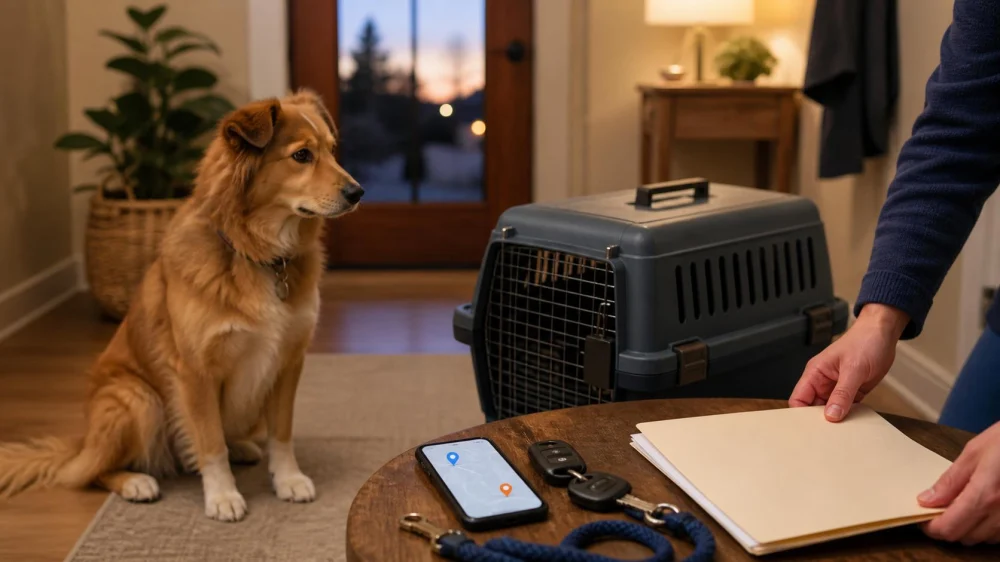
Create a one-page emergency card containing both hospitals, your regular veterinarian, an approved animal poison control resource, the pet's current medicines and conditions, microchip number, insurance information, and two authorized contacts. Keep copies with the carrier and on household phones.
Prepare safe transport. Cats and small dogs generally need a secure, ventilated carrier that can be reached quickly. Larger dogs may need a tested harness and help from a second adult. A painful or frightened animal may bite or scratch; call the hospital for handling guidance and do not put yourself in danger.
Plan for failure points. If the primary hospital stops intake, call the backup before changing direction when possible. If you are traveling, research appropriate hospitals along the route and near the destination. If your pet requires specialty care, ask whether records can be shared in advance.
Important limits and urgent situations
Difficulty breathing, collapse, loss of consciousness, seizure, major trauma, uncontrolled bleeding, suspected poisoning, severe pain, heat illness, rapid abdominal swelling, inability to urinate, repeated unproductive retching, or sudden rapid deterioration can require immediate veterinary attention. This is not a complete list, and symptoms may appear differently across species.
During an active concern, call your regular veterinarian or the emergency hospital for direction while arranging safe transport. Do not rely only on an online directory, review, chatbot, or symptom checklist. Do not give a human medicine, induce vomiting, or offer food or liquid unless a veterinary professional provides case-specific instructions.
If a person is injured, bitten, or exposed to a drug or toxin, seek appropriate human medical or poison-control help. Animal facilities provide veterinary care and may not be the right contact for a human exposure.
Sources and evidence notes
The FDA Center for Veterinary Medicine advises contacting a veterinarian, emergency animal hospital, or animal poison control center for urgent veterinary advice and emphasizes deciding whom to call before time is critical. This article applies that principle to local service preparation. Facility capabilities, intake status, hours, and financial policies must be confirmed directly; they are not inferred from a directory listing.
Frequently asked questions
Should I choose the closest emergency vet?
Travel time is important, but the closest listing may not treat your pet's species, offer the needed service, or be accepting patients. Verify a close primary option and at least one suitable backup with your regular veterinarian.
Can I arrive without calling?
Policies vary. Calling can let the hospital provide transport instructions, confirm the entrance, and warn you about diversion, but do not create an unsafe delay. Follow the hospital's verified process and any direction from your veterinarian.
Why might someone who arrived later be seen first?
Emergency teams commonly prioritize patients by medical urgency. A stable patient may wait while a critically ill animal receives immediate care. Tell staff promptly if your pet's breathing, consciousness, bleeding, pain, or behavior changes.
What should I bring?
Bring the safely contained pet, current medication containers or a verified list, relevant records, identification, payment method, insurance details if used, and any product packaging related to an exposure. Do not delay departure to assemble nonessential items.
How often should I verify the plan?
Check every few months and before travel. Reconfirm after a move, a change in your pet's health, or any notice that a hospital changed hours, ownership, location, or intake procedures.
Next steps
Ask your regular veterinarian which emergency facilities fit your pet, then call a primary and backup hospital during normal conditions. Save their direct numbers and verified entry instructions, drive the route, prepare the carrier, and place a current medical summary in the kit. A 15-minute review now can remove several avoidable decisions from a stressful night later.






 Langley Animal Clinic4.0 (290 reviews)
 SoCal Pet Hospital4.0 (140 reviews)
 Banfield Pet Hospital3.0 (248 reviews)
 Churchman Animal Hospital4.0 (145 reviews)
 50 Fathoms Pet Shop4.0 (964 reviews)
 Metairie Small Animal Hospital4.0 (326 reviews)
 Pet Medication Refill Planning: Avoid Unapproved Dose Changes
 How to Manage Your Pet’s Chronic Pain with Alternative Therapies
 How to Spot and Treat Chronic Skin Conditions in Pets
 How to Tell If Your Dog Has Heart Disease — Coughing, Tiredness and Fainting Signs
 How to Provide Safe and Effective Flea Treatment for Your Pet" — Optimized for the target audience and search engines.
 Pet Bedding Hygiene: A Wash-and-Inspect Routine