
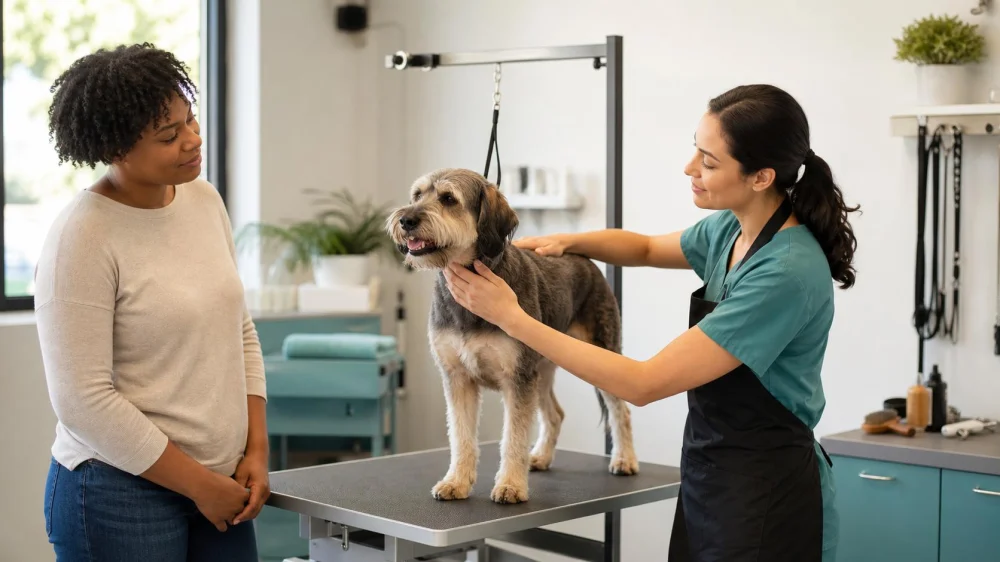
How to Compare Pet Groomers for Your Animal's Needs
On this page
- Quick answer
- Define the grooming need first
- Check provider and species fit
- Ask about handling and environment
- Understand the service process
- Review safety and incident response
- Compare price and policies
- Consultation checklist
- Warning signs
- Limitations and important notes
- Frequently asked questions
- Evidence and practice notes
- Next steps
Quick answer
Compare pet groomers by matching the provider to your animal's species, coat, size, health, behavior, and required services. Ask who will handle the pet, how animals are contained and dried, what prompts a pause, and how incidents are reported. Review the full price and cancellation policy, then start with a consultation or limited service before committing to a complex appointment.
Define the grooming need first
Pet grooming is a set of coat, skin, nail, ear, hygiene, and appearance services performed within a provider's training and business scope. Not every pet needs every service, and not every groomer works with every species, coat, behavior, or medical consideration.
Write a factual profile before contacting providers:
- species, breed or coat type when known, age, size, and current coat condition;
- the specific service requested, such as bathing, brushing, de-shedding, haircut, nail care, or sanitary trimming;
- past grooming experience and known reactions to handling, dryers, clippers, feet, face, or confinement;
- mobility limits, current health conditions, allergies, recent procedures, or veterinarian instructions relevant to handling;
- matting, parasites, wounds, skin changes, pain, or another condition that may alter the appointment;
- your practical goals and any style details that matter.
Share the actual condition rather than minimizing it. A provider needs accurate information to estimate time, determine whether the service is appropriate, and decide if veterinary input is needed first.
Check provider and species fit
Ask how often the groomer works with animals like yours and which services they personally perform. Experience with a cooperative small dog does not automatically transfer to a large dog, cat, rabbit, senior animal, thick double coat, corded coat, or pet that struggles with handling.
Verify current business, licensing, or registration requirements that apply in your part of the United States; rules differ by state and locality. Ask about training, continuing education, insurance, staff supervision, and whether any task is outsourced or completed by a different employee.
For a mobile groomer, in-home provider, salon, veterinary grooming service, or self-service facility, compare the actual setup. The useful format depends on travel stress, medical needs, noise sensitivity, required equipment, and the owner's ability to participate.
Ask about handling and environment
Request a clear description of the handling approach. How does the provider introduce equipment? What signs of stress cause a break, modification, or stop? Who may hold the animal? Are muzzles, loops, kennels, or other safety tools used, and under what conditions?
Look for nonslip work surfaces, secure doors, species-appropriate containment, clean tools, controlled water temperature, ventilation, and a process that prevents animals from mixing unintentionally. Ask whether pets wait in individual enclosures, open areas, or a one-at-a-time setting.
Drying deserves a specific question. Find out whether the provider uses towels, handheld dryers, stand dryers, cage or enclosure dryers, or a combination; how temperature and airflow are monitored; and whether animals are continuously or periodically supervised. Choose an approach that fits the pet and your veterinarian's guidance.
Understand the service process
Ask the provider to walk through arrival, assessment, preparation, bathing, drying, brushing, clipping or trimming, nail care, final check, and pickup. The order may vary, but you should understand what is included and what requires permission.
Clarify these decision points:
- What happens if the coat is more matted than expected?
- Will the groomer call before changing the agreed haircut?
- Which shampoos or topical products are used, and can ingredients be reviewed?
- Are ear plucking, gland expression, tooth brushing, nail grinding, bows, fragrance, or other add-ons included or optional?
- How are before-and-after condition notes recorded?
- When is a service stopped and referred to a veterinarian?
Do not ask a groomer to diagnose or treat a medical condition outside their scope. New lumps, wounds, parasites, severe skin changes, pain, breathing difficulty, or other health concerns should be directed to a veterinary professional.
Review safety and incident response
A responsible provider should be able to explain escape prevention, equipment checks, staff communication, emergency contacts, and what happens after a cut, fall, bite, equipment problem, sudden illness, or other incident. Provide current owner, backup, and veterinary phone numbers.
Ask whether the provider obtains written permission for veterinary care and how payment decisions are handled if you cannot be reached. Confirm the pickup process and who is authorized to collect the pet. For mobile or in-home service, discuss property access and containment at both arrival and departure.
No process eliminates all risk. What matters is whether the provider identifies foreseeable hazards, monitors the animal, communicates promptly, documents incidents, and stops when continuing would be inappropriate.
Compare price and policies
Request a written estimate based on the animal and requested service. Ask what can change the final amount: coat condition, size, time, behavior support, extra staff, specialized products, late pickup, fleas, cancellation, or a missed appointment. A starting price is not the same as a complete quote.
Review deposits, cancellation windows, pickup deadlines, recurring appointment expectations, satisfaction or correction policies, and charges when a service must stop early. Compare value through fit, transparency, handling, environment, and communication—not price or review score alone.
Consultation checklist
- Share the complete pet profile and current photos.
- Confirm the groomer accepts the species, size, coat, behavior, and requested work.
- Ask who will perform each service and how the pet will be contained.
- Review handling, drying, breaks, stop criteria, and veterinary referral boundaries.
- Inspect the accessible environment for security, cleanliness, and organization.
- Confirm products, optional add-ons, and activities you do not authorize.
- Review the estimate, timing, pickup, cancellation, and incident process.
- Provide owner, backup, and veterinary contacts in writing.
- Begin with a consultation, nail visit, bath, or another limited service when a gradual introduction is appropriate.
Warning signs
Pause your search when a provider will not discuss handling or drying, guarantees a result before seeing the animal, dismisses disclosed health or behavior concerns, cannot explain supervision, uses unapproved services, pressures you to hide information, or refuses a clear estimate and policy.
Also reconsider if the entrance permits easy escape, animals appear mixed without control, equipment or surfaces look unsafe, staff cannot identify the person responsible for your pet, or communication changes materially between booking and drop-off. One concern may need clarification; several unresolved concerns are a reason to leave.
Limitations and important notes
A short tour, credential, reference, or online review cannot guarantee how an individual appointment will go. Animals and providers respond differently to noise, handling, equipment, coat condition, and time pressure. Continue evaluating the fit after each visit.
Pets with significant medical needs, severe fear, aggression, mobility limits, sedation needs, or a history of grooming emergencies may require a veterinary setting or coordinated plan. Only a veterinarian should prescribe or direct sedation; do not give unapproved medication to make grooming easier.
Frequently asked questions
Should I stay during my pet's grooming?
Ask the provider. Some animals settle better without the owner visible, while others need a different arrangement. The facility, safety process, and service model determine whether observation is practical.
How often should my pet be groomed?
Frequency depends on species, coat, skin, activity, home care, health, and service type. Ask the groomer for maintenance planning and confirm medical questions with a veterinarian rather than following a universal schedule.
Is shaving a matted coat the only option?
Not always, but severe matting can make prolonged brushing painful or unsafe. The provider should assess the coat, explain workable choices and tradeoffs, obtain permission for a changed plan, and refer health concerns appropriately.
Can a groomer handle an anxious pet?
Some can accommodate mild stress with time, environment, and modified services; others are not equipped for the animal's needs. Describe prior behavior precisely and ask for stop criteria. Veterinary or behavior support may be needed.
What should I check at pickup?
Review the completed services, coat and skin observations, nail result, behavior notes, any incident, and home-care instructions. Report an unexpected concern promptly and seek veterinary advice for injury or illness.
Evidence and practice notes
This guide reflects common professional grooming and animal-care principles: match service to the individual animal, use transparent handling and containment, monitor stress, maintain clean equipment, define scope, document changes, and refer medical concerns to a veterinarian.
No business is endorsed, and no credential, price, or service model guarantees safety or quality. Requirements and accepted practices vary by species, provider, and location.
Next steps
Create your pet profile and send the same questions to two or three suitable providers. Compare their answers in the categories that affect your animal: species experience, handling, drying, containment, stop criteria, communication, and total policy.
Before booking in the United States, verify current local requirements and arrange a consultation. Choose the groomer who explains what they will do, what they will not do, and how they protect the pet when the original plan needs to change.


 Ambassador Animal Hospital4.0 (311 reviews)
 Madden Animal Hospital4.0 (139 reviews)
 Great Neck Veterinary Clinic4.0 (309 reviews)
 Long Veterinary Clinic4.0 (260 reviews)
 Save An Angel's Pet Wellness & Spay/Neuter Clinic4.0 (186 reviews)
 VCA Shaker Road Animal Hospital4.0 (128 reviews)
 The Ultimate Guide to Pet Fitness
 Understanding Cat Obesity: Health Risks and Prevention Tips
 How to Care for Pets with Special Medical Needs
 Expert Advice on Pet Diseases: Symptoms, Prevention, and Real Solutions
 How to Safely Trim Your Dog’s Nails at Home: A Step-by-Step Guide
 Tips for Detecting Early Signs of Cancer in Cats