
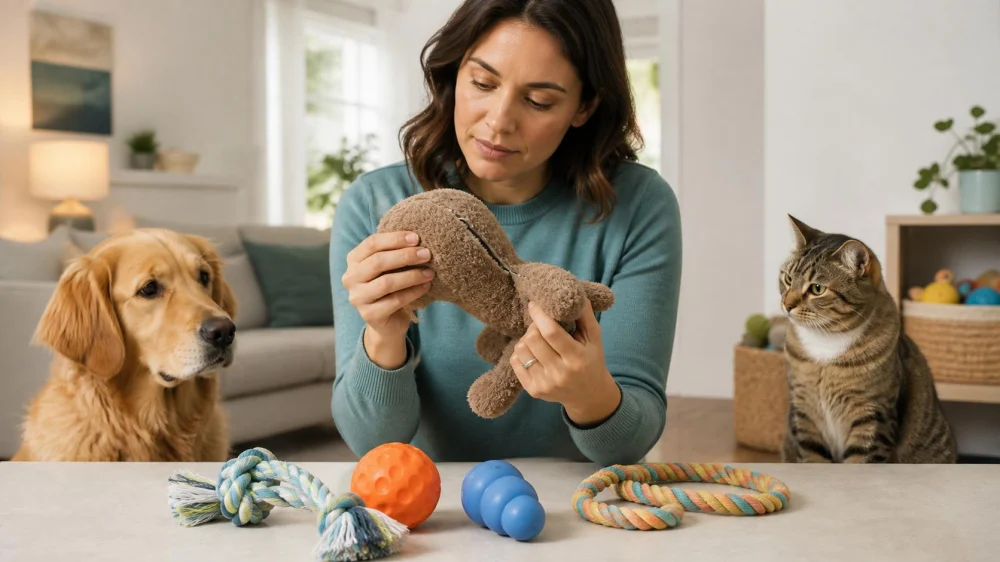
Pet Toy Damage Check: Remove Loose Parts Before Play
On this page
- Quick answer
- Why toy condition matters
- Signs to stop using a toy
- A practical inspection routine
- Match the toy to the pet and play style
- Clean without hiding damage
- Store and rotate toys safely
- If a piece may be swallowed
- Limitations and important notes
- Sources and evidence notes
- Frequently asked questions
- Conclusion and next steps
Quick answer
Inspect pet toys before and after play. Remove any toy with loose pieces, exposed stuffing, sharp edges, split seams, deep cracks, damaged batteries, unraveling rope, or a size that can lodge in the mouth or throat. Do not rely on glue, tape, or a tied knot to restore safety. Replace the toy, supervise the next session, and contact a veterinarian promptly if part is missing or may have been swallowed.
This guide is for dog, cat, and other companion-animal households in the United States. No toy is indestructible or appropriate for every species, size, age, health condition, or play style.
Why toy condition matters
Chewing, pulling, clawing, throwing, moisture, washing, and sunlight change a toy over time. Damage can release pieces that create choking, digestive obstruction, mouth injury, tooth damage, or toxic exposure. Strings and long fibers can be especially dangerous if swallowed.
A toy that was suitable when new can become too small after pieces break off. A pet’s play style can also change with age, confidence, another animal, or a new environment. Regular inspection is more useful than relying on the product’s age alone.
Supervision means active attention. Being in the same home while the pet plays in another room may not provide enough time to interrupt destructive chewing or swallowing.
Signs to stop using a toy
- Pieces, caps, squeakers, bells, eyes, feathers, or decorations are loose or missing
- Stuffing, foam, cord, wire, or an internal mechanism is exposed
- Rope fibers are long, unraveling, or separating into swallowable strands
- Rubber or plastic has deep cracks, sharp edges, brittle areas, or a sticky surface
- A ball or chew has become small enough to fit too deeply in the mouth
- A battery compartment is open, damaged, wet, or shows corrosion
- Fabric seams split, hard parts protrude, or the toy no longer keeps its intended shape
- Odor, mold, residue, or contamination remains after approved cleaning
Remove questionable toys calmly and trade for a safe reward rather than chasing a guarding pet. Seek behavior guidance if resource guarding makes retrieval unsafe.
A practical inspection routine
- Identify the toy. Keep packaging or a photo of its original condition and manufacturer instructions.
- Count detachable features. Know how many pieces, knots, or attachments were present.
- Look under bright light. Check seams, edges, holes, attachment points, and the area around any sound mechanism.
- Flex gently. Look for cracks that open under normal movement without pulling the toy apart.
- Compare the size. Make sure the whole toy and any worn section remain appropriate for the pet’s mouth and play style.
- Check after cleaning. Heat, water, and detergents can reveal or worsen separation.
- Retire or replace. Remove unsafe items from all pets’ reach before discarding them securely.
Match the toy to the pet and play style
Choose toys designed for the animal’s species and intended activity. A fetch toy may not be designed for unsupervised chewing. A puzzle toy may require size-specific pieces and direct supervision. Cat wand strings should be stored out of reach after interactive play.
For strong chewers, select an appropriate size and material, but do not assume a “tough” label means damage cannot occur. Very hard items can also create dental risk for some pets. Ask a veterinarian about chew choices for animals with dental disease, jaw conditions, restricted diets, or a history of swallowing objects.
In multi-pet homes, choose for the pet most likely to misuse the item. A toy sized for a small animal may become a swallowing hazard for a larger one, while rough group play can add force the design was not intended to handle.
Clean without hiding damage
Follow the manufacturer’s cleaning method. Some toys are machine washable or dishwasher compatible; others can trap water, deform with heat, or damage electronic parts. Use pet-appropriate products, rinse as directed, and dry completely.
Do not soak battery toys unless explicitly allowed. Remove a toy that develops trapped moisture, mold, corrosion, or a new chemical odor. Cleaning cannot restore torn casing, weakened seams, damaged electronics, or missing material.
Inspect before washing so a loose part is not lost in the machine, then inspect again after drying. Discard cleaning water and damaged material so pets cannot retrieve them.
Store and rotate toys safely
Keep interactive strings, wands, small puzzle parts, and battery toys in a closed container the pet cannot access alone. Separate clean toys from wet or damaged items. Store away from heat and sunlight when the material can degrade.
Rotation can keep interest high and makes inspection easier. Keep a small number available, then swap only after checking each one. Wash storage bins periodically and remove broken fragments from the bottom.
Do not leave a toy in a crate or unsupervised area unless it is appropriate for that pet and use. When in doubt, provide a safer environment rather than testing durability without observation.
If a piece may be swallowed
Contact a veterinarian or veterinary emergency service promptly and describe the pet, toy material, missing size and shape, possible time, and any symptoms. Keep packaging and an intact matching piece or photograph when available.
Do not induce vomiting or give food, oil, medication, or another home remedy unless a veterinarian or animal poison professional specifically directs it. Sharp, long, caustic, magnetic, or battery-containing objects can require urgent specialized decisions.
Seek emergency care for choking, trouble breathing, collapse, repeated unproductive retching, severe distress, persistent vomiting, a painful or swollen abdomen, marked lethargy, inability to keep water down, or another rapidly worsening sign. Do not pull string from the mouth or anus; internal attachment can make pulling dangerous.
Limitations and important notes
- Product age labels and “indestructible” marketing do not guarantee suitability.
- Glue, tape, staples, and home stitching can add new hazards or hide weakness.
- Batteries and magnets are urgent ingestion hazards; contact professionals immediately.
- Rope and string fragments can cause serious internal injury even when they look soft.
- Behavior, dental health, and medical history can change which toys are appropriate.
Sources and evidence notes
This article reflects broad veterinary safety practice: match toys to the pet, supervise intended use, remove damaged or undersized items, avoid inducing vomiting without direction, and seek prompt advice for suspected foreign-body ingestion.
Use current manufacturer instructions and guidance from the pet’s veterinarian or an animal poison service for a specific exposure. No toy or repair is guaranteed safe here.
Frequently asked questions
Can I sew a ripped plush toy?
A repair may hide weakened fabric or introduce thread that can be swallowed. Replace it unless the manufacturer provides an approved repair and the pet’s play style makes reuse appropriate.
Are rope toys safe to leave out?
They require inspection and often supervision. Remove them when fibers unravel or the pet tries to swallow strands.
How small is too small for a ball?
There is no universal size. It must not fit too deeply behind the pet’s teeth or lodge in the mouth or throat. Ask a veterinarian for the individual pet.
Can I wash toys with household detergent?
Use only the toy maker’s method and pet-appropriate products, rinse as directed, and dry completely. Discard any toy with residue or damage.
What if a squeaker is missing?
Treat it as possible ingestion and contact a veterinarian promptly, even if the pet currently seems normal.
Conclusion and next steps
Make toy inspection part of play: check seams, size, edges, attachments, and internal parts before and after use. Remove damage rather than repairing it with household materials, and store high-risk interactive toys securely. If any piece is missing, contact a veterinarian with the toy details and do not wait for severe symptoms.



 Countryside Animal Clinic PC4.0 (71 reviews)
 Petco4.0 (909 reviews)
 Petco4.0 (677 reviews)
 Higley Groves Animal Hospital4.0 (523 reviews)
 Avalon Veterinary Hospital4.0 (738 reviews)
 PetVet Vaccination Clinic0.0 (0 reviews)
 How to Help Pets Cope with Separation Anxiety: Tips and Solutions
 How to Provide Comfort for Pets with Cancer
 Is Your Pet’s Mental Health on Track? Signs, Causes & What to Do
 Preventing Obesity in Indoor Dogs with Daily Exercise – Effective Tips
 How to Recognize and Treat Infections in Your Pet’s Mouth
 How to Safely Clean Your Pet’s Ears and Prevent Infections: Expert Tips