
How to Compare Pet Boarding Facilities Before Booking
On this page
- Quick answer
- Start with your pet’s needs
- Visit and inspect the facility
- Ask about staff and supervision
- Review health and emergency policies
- Understand the daily care plan
- Evaluate group play and handling
- Read the contract and total cost
- Trial stay and booking checklist
- Limits and important notes
- Sources and evidence notes
- Frequently asked questions
- Conclusion and next steps
Quick answer
Compare pet boarding facilities by matching care to your animal, touring the space, and confirming staffing, overnight supervision, cleaning, ventilation, temperature control, exercise, group-play screening, medication, vaccination, isolation, and emergency procedures. Read the full price and contract, verify required licensing where applicable, and use a short trial stay before a long trip when your pet’s health and temperament allow.
Start with your pet’s needs
A boarding facility that works for a social young dog may not fit an older cat, an anxious dog, a rabbit, a pet needing medication, or an animal with mobility or medical needs. Write a care profile before contacting facilities.
Include species, age, size, diet, medication, allergies, mobility, toileting routine, sleep habits, handling sensitivities, separation response, behavior around animals and people, and past boarding experience. Ask your veterinarian whether boarding is appropriate when a pet has a medical condition, recent surgery, contagious illness, pregnancy, or significant stress response.
This guide is for U.S. pet owners comparing commercial boarding. Rules, licensing, inspections, vaccination requirements, and emergency arrangements vary by state and locality. Individual health decisions belong to a licensed veterinarian.
Visit and inspect the facility
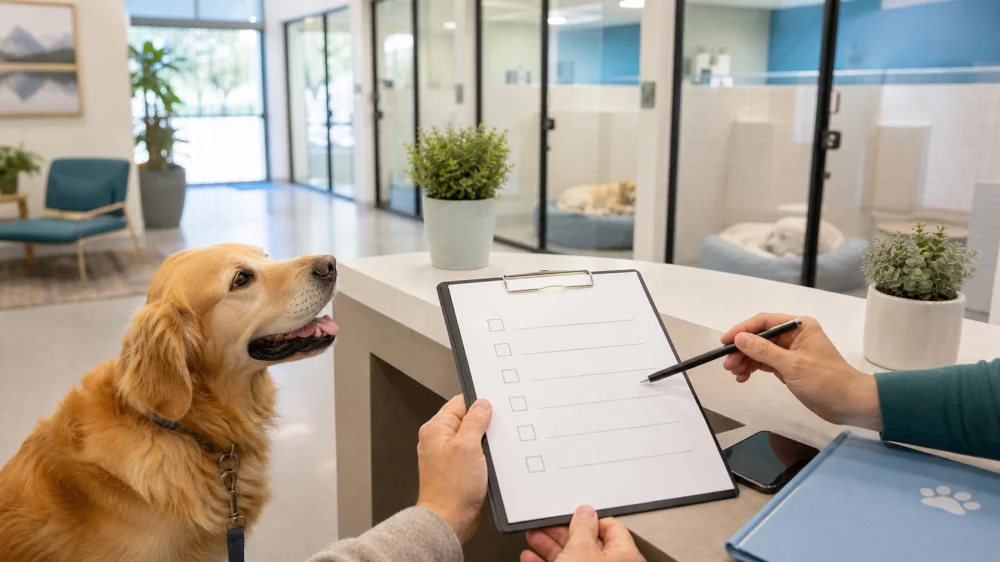
Request a tour during normal operations when allowed. Security or animal stress may limit access to some areas, but staff should be able to explain and show the care environment through an appropriate method.
Look and listen for:
- Secure entry, double-gate systems, intact enclosures, and safe door procedures.
- Clean, dry resting spaces without overwhelming odor.
- Ventilation, temperature control, lighting, drainage, and noise management.
- Separate areas for species, size, behavior, rest, feeding, and isolation.
- Non-slip surfaces and bedding appropriate to the animals.
- Fire, weather, power-outage, evacuation, and backup plans.
A strong fragrance can mask odor and may bother some animals. A quiet moment does not prove the facility is always calm. Ask how noise, cleaning chemicals, and peak occupancy are managed.
Ask about staff and supervision
Find out who is onsite during the day, evening, overnight, weekends, and holidays. “24-hour monitoring” may mean a person onsite, remote cameras, scheduled rounds, or an on-call employee. Ask for the exact arrangement.
Ask how staff are trained in animal behavior, low-stress handling, first aid, medication, sanitation, escape prevention, and emergency response. Confirm staff-to-animal practices during play, feeding, cleaning, and nighttime care; there is no single number that fits every housing model.
Learn how observations are documented and escalated. A useful process records appetite, water intake, elimination, medication, activity, behavior, and concerns, then states when a supervisor, owner, or veterinarian is contacted.
Review health and emergency policies
Request current vaccination, parasite, illness, and exposure requirements before booking. Requirements should reflect species and facility policy. Ask what happens when an animal arrives coughing, vomiting, having diarrhea, or showing skin or eye symptoms.
Confirm the isolation area and cleaning response for possible contagious disease. No facility can guarantee that exposure will never occur, but it should have a clear prevention and response plan.
For emergencies, ask:
- Which veterinary clinic or emergency hospital is used.
- Who transports the pet and how.
- When the owner or backup contact is called.
- What spending authorization is required.
- How medical records, insurance, and payment are handled.
- What happens if the listed veterinarian is unavailable.
Provide your own veterinarian and emergency contact information. The U.S. Food and Drug Administration advises contacting a veterinarian or emergency animal hospital for veterinary emergencies; boarding staff should not improvise treatment beyond their lawful training and instructions.
Understand the daily care plan
Ask for a sample schedule. Confirm feeding times, water access, elimination breaks, walks, individual attention, rest periods, cleaning, and lights-out. Determine which activities are included and which cost extra.
Bring the pet’s regular food when allowed and label each portion. Sudden diet changes can cause digestive upset. Ask how bowls are cleaned, food is stored, and uneaten meals are recorded.
For medication, request the policy before booking. Confirm accepted medication types, original packaging, timing accuracy, refrigeration, controlled-drug handling, administration fees, missed-dose response, and who is trained to give it. Do not place loose pills in food without the facility’s documented process.
Ask how cats and other species receive hiding space, litter care, species-appropriate enrichment, and protection from dog noise or visual contact.
Evaluate group play and handling
Group play is not necessary or suitable for every pet. Ask how dogs are screened, grouped by size and play style, introduced, supervised, rested, and removed when behavior changes. Find out which tools or correction methods staff use.
Large uninterrupted play groups can create fatigue and conflict. Look for planned rest, manageable group composition, and staff who can describe subtle stress signals rather than waiting for a fight.
If your pet does not enjoy group play, ask about individual walks, solo yards, visual barriers, and enrichment. Never hide bite, escape, guarding, or fear history; accurate disclosure protects your pet, staff, and other animals.
Read the contract and total cost
Calculate the full stay: base nightly rate, peak or holiday surcharge, medication, special feeding, individual play, walks, late pickup, early drop-off, grooming, transport, cancellation, and emergency charges.
Review:
- Check-in and checkout times and how partial days are billed.
- Deposit, refund, cancellation, and no-show rules.
- Emergency treatment and spending authorization.
- Illness, injury, escape, and property liability language.
- Photo, video, webcam, and marketing consent.
- Items the facility accepts, stores, or will not replace.
- Early pickup or removal when a pet cannot be safely housed.
Get material promises in writing and keep a complete copy. A waiver does not answer whether the care plan fits your pet or determine every legal right.
Trial stay and booking checklist
- Ask your veterinarian about medical readiness and required preventive care.
- Verify any facility license or inspection required locally.
- Tour and compare at least two suitable facilities.
- Confirm exact daytime, nighttime, and emergency staffing.
- Review health, isolation, handling, medication, and escape procedures.
- Calculate the full cost and read the contract.
- Provide accurate behavior and medical information.
- Try daycare or one overnight stay when appropriate.
- After the trial, review appetite, elimination, sleep, behavior, skin, and any facility notes.
- Leave veterinarian, backup contact, travel, and written emergency authorization details.
Limits and important notes
Reviews and photos can be old, selective, or unverified. Use them to identify recurring questions, then confirm current operations directly. A clean tour does not guarantee every shift or future stay.
Some stress after boarding can occur, but persistent vomiting, diarrhea, coughing, breathing difficulty, injury, severe lethargy, inability to urinate, collapse, or rapid deterioration requires veterinary contact. Do not diagnose changes solely as “boarding stress.”
For pets whose medical, behavioral, or species needs exceed a facility’s capability, consider veterinary boarding, a qualified in-home sitter, or another individualized plan.
Sources and evidence notes
This article reflects common animal-care and risk-management practice: match care to the animal, inspect housing, verify supervision and sanitation, prevent disease, document medication, plan veterinary emergencies, disclose behavior, and use a trial when appropriate.
Use current state and local rules, facility documentation, your veterinarian, and emergency animal hospital information. General guidance cannot certify a facility or predict an individual pet’s response.
Frequently asked questions
Is someone always onsite at a boarding facility?
Not necessarily. Ask what happens overnight and whether monitoring is onsite, remote, scheduled, or on-call.
Does my dog need group play?
No. Individual activity may be safer or less stressful. Choose based on temperament and the facility’s assessment.
Should I bring my pet’s own food?
Often yes, when allowed, to reduce diet change. Follow packaging and portion instructions from the facility.
Can boarding staff give medication?
Policies, training, and lawful scope vary. Confirm the exact medication, schedule, packaging, fee, and missed-dose plan.
What should I learn from a trial stay?
Review facility notes and your pet’s appetite, elimination, sleep, behavior, and health after return. Discuss concerning changes with a veterinarian.
Conclusion and next steps
Create a one-page profile of your pet, then visit two facilities that can meet those needs. Compare security, housing, staff, overnight coverage, health policies, daily care, group management, emergencies, contract, and full cost. Use a short trial when suitable and leave complete records and contacts. The best choice is the facility that can explain exactly how it will care for your specific animal.






 Companion Pet Clinic of Gold Canyon4.0 (282 reviews)
 Pinehills Veterinary Hospital4.0 (100 reviews)
 Local Mobile Veterinary Service4.0 (52 reviews)
 Companion Animal Veterinary Service4.0 (161 reviews)
 Animal Medical Center of Plano4.0 (705 reviews)
 Vetco Vaccination Clinic4.0 (10 reviews)
 Understanding Pet Behavior: How to Address Common Issues
 How to Spot and Treat Allergic Reactions in Pets
 Understanding Canine Diabetes and Dietary Needs: A Guide for Pet Owners
 Common Signs of Arthritis in Senior Cats: What to Look For and How to Help
 How to Introduce Multiple Cats to a Single Household: Expert Tips for a Smooth Transition
 How Annual Wellness Exams Can Add Years to Your Pet’s Life in the US