
Cat Straining in the Litter Box: Treat It as Urgent
On this page
Quick answer
A cat repeatedly straining in the litter box, making frequent trips, crying, or producing little or no urine may have a urethral obstruction—a life-threatening emergency, especially in male cats. Call an emergency veterinarian and leave promptly. Do not wait for a full day, squeeze the abdomen, give medicine, or assume constipation. A blocked cat needs immediate examination and veterinary treatment.
This guide is for cat owners in the United States. Urinary and bowel signs can look similar, and only a veterinarian can determine the cause. When you cannot confirm normal urine production, treat the situation as urgent.
Why urinary blockage is an emergency
A urethral obstruction prevents urine from leaving the bladder. The bladder becomes painful and overdistended, while the body loses the ability to eliminate wastes and maintain safe fluid and electrolyte balance. Without relief, the condition can deteriorate rapidly and become fatal.
Cornell University College of Veterinary Medicine calls urethral obstruction a true medical emergency and notes that time from complete blockage to death may be less than 24 to 48 hours. Immediate treatment is essential; this is not a condition to monitor overnight.
Male and neutered male cats are at increased risk because their urethra is longer and narrower, but cats of any sex with painful or abnormal urination need prompt evaluation. Lower urinary tract signs can also come from inflammation, stones, infection, trauma, tumors, or other causes. Similar appearance does not mean similar treatment.
Signs to observe without delaying care
While another person calls the clinic, note:
- repeated litter-box visits within a short period;
- squatting or straining with little or no visible urine;
- small urine spots, droplets, or blood;
- crying, growling, panting, restlessness, or hiding;
- licking the genital area repeatedly;
- urinating outside the box;
- a tense, painful posture or reluctance to move;
- vomiting, loss of appetite, weakness, or collapse; and
- an abdomen that appears painful or distended.
Do not wait for every sign. Early obstruction can resemble cystitis or constipation, and an owner may not see whether a small clump belongs to another cat. In a multi-cat home, isolate the symptomatic cat only long enough to prepare transport if doing so is calm and safe—not to conduct a prolonged urine test.
A video of the posture or a photo of the litter clumps may help, but never delay departure to create evidence. Do not repeatedly place the cat in the box.
What to say when you call
Use a direct opening: “My cat is repeatedly straining and may be producing little or no urine. I am concerned about a urinary blockage.” Provide:
- sex, neuter status, age, weight, and relevant conditions;
- when normal urination was last confirmed;
- how many attempts occurred and what urine, blood, or stool was seen;
- pain, crying, vomiting, weakness, collapse, or breathing changes;
- previous urinary blockage, crystals, stones, bladder disease, or surgery;
- medication and prescription diet;
- possible trauma or toxin exposure; and
- estimated travel time and whether the cat can be handled safely.
If the regular clinic is closed or cannot evaluate immediately, ask for the nearest emergency hospital. Call before leaving when possible so staff can prepare, but do not let an unanswered line create a long delay; use another emergency service.
Prepare safe transport
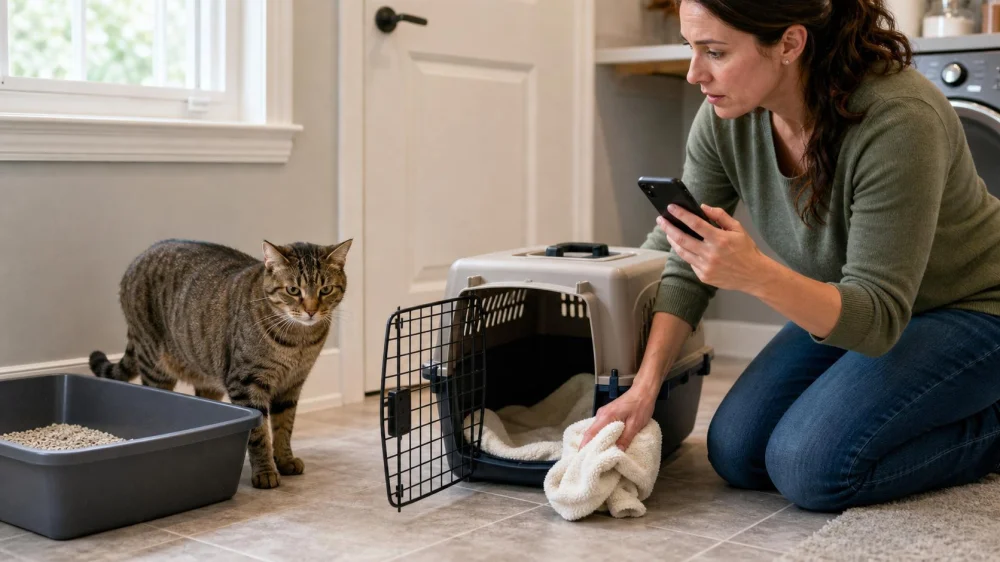
- Use a secure carrier. A top-opening or removable-top carrier may reduce handling at the clinic. Line it with a clean absorbent towel or pad.
- Move calmly. Pain can cause defensive behavior. Keep children and other pets away and avoid pressure on the abdomen.
- Do not force food or water. The cat may need sedation or anesthesia. Follow the emergency team’s instruction.
- Bring records. Pack medication names, recent test results, prescription food details, and the regular veterinarian’s contact information without delaying departure.
- Control temperature. Keep the carrier in the climate-controlled passenger area, stable and secured. Do not place it loose in a truck bed or closed trunk.
- Drive safely. Have another adult monitor the cat when possible. If the cat collapses or has breathing difficulty, update the hospital while continuing safely.
Do not allow the cat to roam inside the vehicle. Pain, panic, or sudden weakness can interfere with driving and make clinic transfer harder.
What not to do at home
Do not press or squeeze the bladder. A painful abdomen is not a home diagnostic test, and pressure can cause injury. Do not massage the urethra or attempt to express urine.
Do not give human pain medicine, antibiotics, diuretics, urinary supplements, leftover veterinary drugs, or another pet’s prescription. Some human medicines are highly toxic to cats, and medication does not remove a mechanical obstruction.
Do not change to a special diet and wait for it to dissolve the problem. Diet is part of long-term management for selected conditions; it cannot safely relieve an acute obstruction at home.
Do not offer large amounts of water by syringe. Aspiration is possible, and the cat may require anesthesia. Do not induce vomiting.
Do not assume a bowel movement rules out urinary blockage, or that passing a few drops means the urethra is open. Partial flow can become complete obstruction.
Do not delay because the cat becomes quiet. Increasing weakness, reduced responsiveness, vomiting, or collapse can reflect worsening illness, not improvement.
Aftercare and monitoring limits
Treatment can include stabilization, pain control, blood tests, urinary catheterization under sedation or anesthesia, imaging, intravenous fluids, and hospitalization. The plan depends on cause and severity.
After discharge, follow instructions exactly for medication, diet, water access, litter boxes, activity, and recheck. Monitor urine output rather than only box visits. In a multi-cat home, temporary separation may make monitoring possible if the veterinarian recommends it.
Return immediately for renewed straining, small or absent urine, crying, vomiting, weakness, hiding, appetite loss, or any concern that the blockage has returned. Recurrence is possible, and the emergency threshold remains the same.
Long-term prevention is individualized. It may involve urine testing, imaging, prescription nutrition, increased water intake, weight management, environmental changes, litter-box access, medication, or surgery in selected recurrent cases. Do not switch food or supplements without the treating veterinarian.
Frequently asked questions
How can I tell constipation from urinary blockage?
You may not be able to. Both can cause straining. If normal urine is not confirmed, seek immediate veterinary evaluation.
My male cat passed a few drops. Is that enough?
No. Small drops can occur with partial or complete urinary disease and do not prove safe bladder emptying.
Can a female cat become blocked?
Yes, although male cats are at higher risk. Any cat with little or no urine and distress needs urgent care.
Can stress cause these signs?
Stress can be associated with feline urinary tract disease, but it does not rule out obstruction. Emergency evaluation comes first.
Should I clean the litter box before leaving?
No if it delays care. A quick photo or sample information may help, but the cat is the priority.
Will a warm bath help the cat urinate?
No. It delays treatment and may increase stress or cause injury. A urinary obstruction needs veterinary relief.
Sources and evidence notes
Cornell Feline Health Center describes lower urinary tract signs, explains that urethral obstruction is a true medical emergency, and notes rapid deterioration without relief. See Cornell guidance on feline lower urinary tract disease.
UC Davis School of Veterinary Medicine also lists straining, frequent small urination, blood, pain, and urethral obstruction among lower urinary tract signs. See UC Davis feline urinary disease overview. An individual emergency veterinarian’s instructions take priority.
Conclusion and next steps
If a cat strains repeatedly or produces little or no urine, call an emergency veterinarian and go now—especially for a male cat. Observe only while preparing transport, use a secure carrier, and avoid abdominal pressure, medicine, forced fluids, or diet experiments. Even a few drops do not rule out obstruction. Rapid treatment protects the kidneys, heart rhythm, bladder, and life.





 Banfield Pet Hospital4.0 (156 reviews)
 Woodman Julie DVM4.0 (4 reviews)
 Oswego Veterinary Clinic4.0 (120 reviews)
 Noll Veterinary Hospital4.0 (508 reviews)
 Springfield Veterinary Clinic4.0 (251 reviews)
 Ramsey, Molly DVM5.0 (7 reviews)
 How to Train Your Pet to Be Comfortable Around Strangers
 Pet Food Labels: Find the Facts That Guide Daily Feeding
 How to Care for Exotic Pets: Tips for Special Pet Owners
 How to Recognize and Treat Allergies in Dogs and Cats
 How to Spot and Treat Hypothyroidism in Dogs and Cats
 How to Manage Pet Allergies to Food or Environmental Triggers