
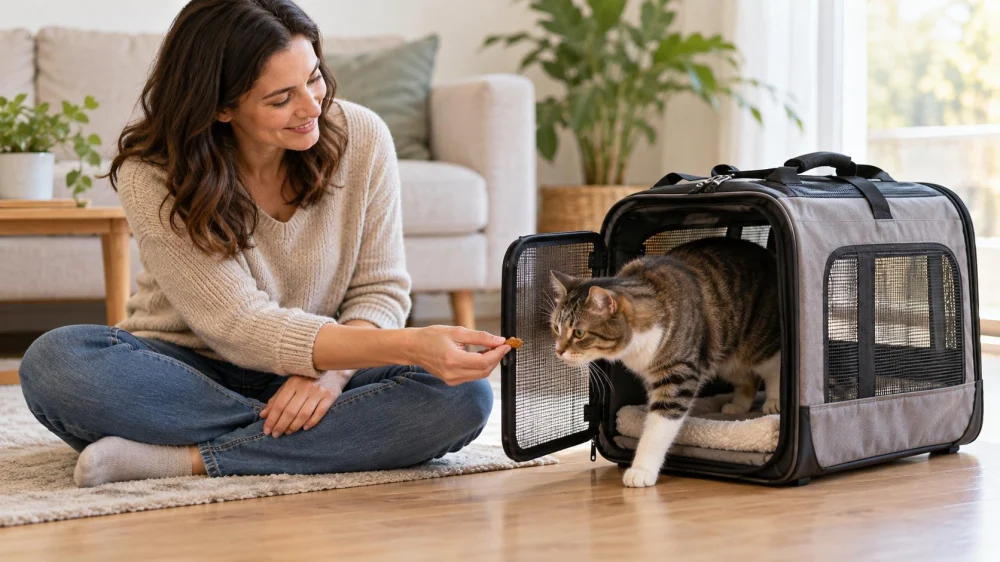
Choosing a Pet Carrier: Fit, Ventilation, and Secure Travel
On this page
Quick answer
Choose a pet carrier that fits the animal in a natural standing, turning, and resting position while remaining small enough to limit unsafe movement during transport. Confirm ventilation, secure latches, strong seams, a leak-resistant base, safe handles, and the exact vehicle or carrier rules for the trip. Introduce it at home before travel and secure it so it cannot slide, tip, or become a projectile.
A carrier is a temporary transport enclosure, not a substitute for daily living space. The correct design depends on species, body shape, health, behavior, travel mode, climate, and destination requirements. A veterinarian can advise when a pet has breathing, mobility, anxiety, or medical concerns.
Measure the pet and define the trip
Measure from floor to the top of the head or ears in a natural stance, from nose to base of tail, and across the widest body point. Weigh the pet and compare every measurement with the manufacturer’s usable interior dimensions and weight rating. Exterior dimensions include handles and wheels and may not describe interior room.
Then define the trip: short car visit, emergency evacuation, public transit, air travel, hotel stay, or long-distance move. Check current requirements from the actual airline, train, bus, lodging, clinic, shelter, or border authority. A product advertised as “airline approved” is not a guarantee that it fits a particular flight or seat.
Compare carrier types
- Hard-sided: protective structure, easy-clean surfaces, and secure doors; may be heavier and less adaptable to tight spaces.
- Soft-sided: lighter and sometimes easier to carry; seams, mesh, zippers, and shape retention require close inspection.
- Top-loading: can make placing some cats or small animals easier; the top closure must be strong and secure.
- Crate-style: useful for larger dogs and some vehicle setups; confirm structure, spacing, anchoring, and travel requirements.
- Backpack or wheeled: may help the person carrying, but ventilation, stability, orientation, temperature, and motion need evaluation.
Fashion, color, pockets, and folding convenience come after safe fit and construction. Avoid protrusions, loose cords, sharp edges, or mesh a pet can tear or catch claws in.
Inspect fit, ventilation, and closures
Place the carrier on a stable floor and check that the pet can stand naturally, turn without force, and lie in a normal position. Watch ears, tail, shoulders, and joints. Extra-large space can allow dangerous tumbling in motion, so seek veterinarian or transport guidance for the specific pet.
Ventilation openings should provide airflow without allowing escape or trapping body parts. Check that bedding does not block them. Test every latch and zipper, including whether a clever or anxious pet can push it open. Zipper clips or manufacturer-approved locks may add security, but they must not delay emergency access.
Lift the empty carrier by each intended handle and inspect attachment points. Add the pet only after verifying the base stays level and the rated load is appropriate. Use an absorbent liner that lies flat and does not bunch around the pet.
Introduce the carrier gradually
Leave the carrier open in a familiar room with stable bedding and treats or toys appropriate for the pet. Let exploration occur without immediately closing the door. Feed near it, then inside if the veterinarian or behavior plan supports that approach.
- Reward calm approach and entry.
- Close the door briefly, then reopen before distress escalates.
- Practice lifting a short distance with level support.
- Try a brief stationary vehicle session, then a short trip.
- Increase duration gradually while monitoring comfort.
Do not force a panicking pet into repeated long sessions. A veterinarian or qualified behavior professional can help with fear, and any medicine should be used only as prescribed for that animal and trip.
Secure it for travel
In a vehicle, place the carrier where the manufacturer and vehicle instructions permit it to be restrained. A loose carrier can move in a sudden stop. Do not place it where an airbag could cause harm or where luggage can fall onto it. Never transport a pet in a closed trunk or unsecured open truck bed.
Maintain safe temperature and airflow. Do not leave a pet unattended in a parked vehicle. During stops, keep doors and windows controlled before opening the carrier, and use a secure secondary barrier or leash only when appropriate for the species and pet.
Attach identification and contact information without exposing unnecessary personal data. Keep a recent photo, health information, medicines, water, cleanup supplies, and emergency contacts accessible outside the carrier.
Limitations and safety notes
Carrier requirements can change and differ by travel provider, route, aircraft, vehicle, jurisdiction, and animal. Verify current rules directly. Brachycephalic animals, seniors, very young pets, and animals with heart, lung, mobility, or anxiety concerns may need special veterinary planning.
Seek urgent veterinary help for breathing difficulty, collapse, severe overheating, repeated vomiting, injury, or another emergency. Do not cover ventilation or sedate a pet without explicit veterinary direction.
Sources and evidence notes
This guide follows common veterinary and transport-safety principles: select by measured fit and construction, acclimate gradually, protect ventilation and temperature, and restrain the carrier during vehicle travel. Provider-specific rules take priority.
Frequently asked questions
Should the carrier be as large as possible?
No. It should allow natural positioning without excessive room for unsafe movement. Ask a veterinarian or transport professional for the pet and travel mode.
Can two pets share one carrier?
Do not assume this is safe or permitted. Stress, injury, size, relationship, and provider rules matter. Separate carriers are often required.
Is a soft carrier safe for a cat?
It can be when sized correctly and built with secure seams, mesh, zippers, and structure. Inspect the specific cat’s ability to push, claw, or chew.
Can I use a carrier with wheels?
Check stability, ventilation, surface vibration, and whether it remains upright. Carry rather than roll where bumps, stairs, heat, or crowds make rolling unsafe.
When should I replace a carrier?
Replace or professionally assess it after cracked structure, damaged mesh, weak seams, failed latches, heavy contamination, or any change that compromises fit or security.
Conclusion and next steps
Measure the pet, define the exact trip, and inspect the carrier’s usable space, airflow, closures, base, and carrying points. Build comfort through short practice sessions and secure the carrier according to vehicle and manufacturer instructions. Recheck provider rules and the pet’s health before every major journey.






 Animal Clinic of S.E. Kansas4.0 (225 reviews)
 Ireland Animal Clinic PC: Neuhoff Kathleen T DVM4.0 (7 reviews)
 Petco4.0 (1039 reviews)
 Villa Rosa Veterinary Hospital4.0 (227 reviews)
 On Point Animal Hospital Surfside4.0 (746 reviews)
 Newburgh Veterinary Hospital4.0 (722 reviews)
 How to Improve Your Pet’s Dental Health: Expert Tips and Daily Care
 How to Recognize and Treat Common Pet Diseases: A Complete Guide
 How to Help Your Pet Overcome Separation Anxiety: Effective Strategies
 Choosing the Right Hypoallergenic Cat Food for Sensitive Stomachs
 Pet Harness Fit: Movement, Chafing, and Escape Risk
 Pet Poison Prevention: Store Common Hazards Out of Reach