
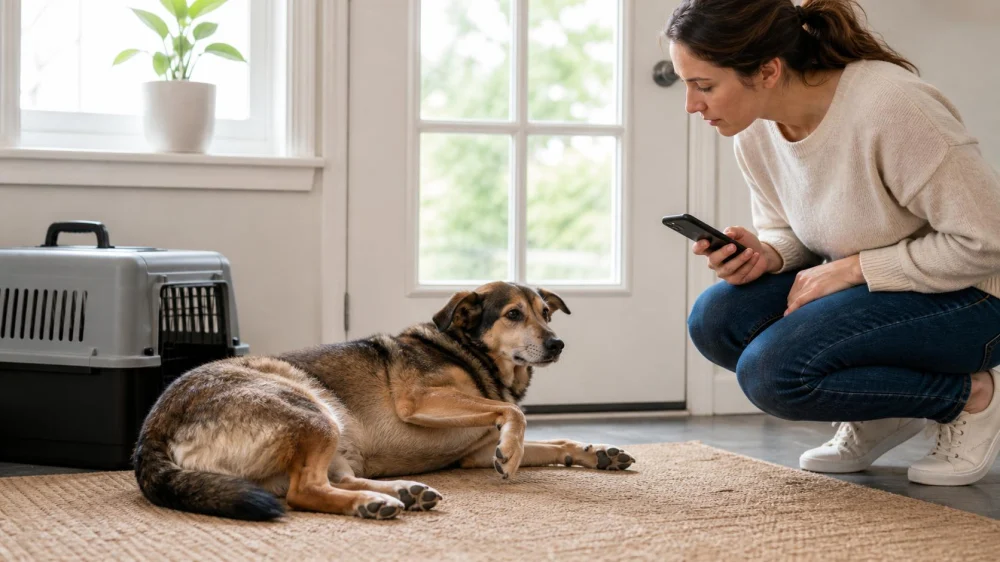
Dog Suddenly Limping: Triage Before You Move Them
On this page
Quick answer
A dog that suddenly limps is showing pain, weakness, or loss of normal limb use. Stop activity, keep the dog calm, and prevent stairs, running, and jumping. Seek emergency veterinary care for inability to bear weight, severe pain, obvious fracture or deformity, heavy bleeding, dragging limbs, collapse, breathing trouble, major trauma, or worsening neurologic signs. Do not give human pain medicine.
This guide is for dog owners in the United States. Limping cannot be diagnosed safely from appearance alone; muscles, joints, bones, paws, nails, nerves, spine, and systemic illness can produce similar signs. Call a veterinarian for case-specific triage.
When limping needs emergency care
Go to an emergency veterinary hospital or follow immediate veterinary instructions when the dog has:
- complete inability to bear weight on a limb;
- an obvious fracture, joint at an abnormal angle, dangling limb, or exposed bone;
- uncontrolled bleeding, a deep puncture, severe swelling, or a large open wound;
- been hit by a vehicle, fallen from height, suffered a crushing injury, or had another major trauma;
- sudden dragging, knuckling, paralysis, inability to stand, loss of balance, or severe back or neck pain;
- crying, shaking, snapping from pain, inability to settle, or rapidly worsening distress;
- pale, blue, gray, or very dark red gums, breathing difficulty, weakness, collapse, or altered awareness;
- a swollen or painful abdomen, repeated nonproductive retching, or severe vomiting with weakness;
- a limb that is cold, discolored, or rapidly enlarging; or
- a suspected venomous bite, penetrating object, gunshot, or severe burn.
Cornell’s emergency service lists non-weight-bearing lameness, difficulty walking, and pain among signs that can require emergency evaluation. Call ahead while someone else safely prepares transport.
Approach and move the dog safely
Pain can make even a gentle dog bite. Approach quietly, avoid the injured area, and keep children and other animals away. Use a leash if the dog can walk safely. Do not force a dog to stand for examination.
For a small dog, support the chest and pelvis together and keep the spine level. Place the dog in a sturdy carrier when possible. For a large dog that cannot walk, use a rigid board or a blanket as a stretcher with enough adults to keep the body stable. Follow emergency staff instructions.
A temporary muzzle may protect handlers only when appropriate and when the dog can breathe normally. Never muzzle a dog that is vomiting, having trouble breathing, overheated, unconscious, or has facial injury. Do not delay transport to improvise equipment.
Keep the dog from jumping into a vehicle. Use a ramp only if it is secure and walking is permitted; otherwise lift or use a stretcher. Drive smoothly and restrain the carrier or stretcher so it cannot slide.
A brief check without causing more pain
If the dog is calm, stable, and able to bear some weight, observe before touching:
- which limb is affected and whether the limp appears on every step;
- whether the paw is held up, toes knuckle under, or the leg swings differently;
- swelling, bleeding, a torn nail, cut pad, foreign object, or insect sting;
- heat, asymmetry, or a visibly displaced joint;
- back arching, head held low, reluctance to turn, or other signs that the spine may be involved; and
- general signs such as lethargy, feverishness, poor appetite, vomiting, or breathing change.
Look between toes and at the nail surfaces only if the dog allows. Do not squeeze joints, pull the limb, compare range of motion, cut into a pad, dig for a deep object, or try to “put a joint back.” Stop immediately if the dog resists or pain increases.
Do not remove a deeply embedded object because it may be limiting bleeding or near important structures. Stabilize the area loosely without pressing the object and seek emergency care.
What to record for the veterinarian
Veterinarians use history and examination to locate the source of lameness. Record:
- exact onset time and whether it was sudden or gradual;
- activity just before onset—running, jumping, rough play, stairs, slippery floor, grooming, or rest;
- known fall, collision, bite, puncture, or object stepped on;
- front or hind limb and whether the dog bears full, partial, or no weight;
- whether signs improve after rest or worsen after activity;
- swelling, heat, sound, wound, nail damage, or neurologic change;
- medications, supplements, medical conditions, previous orthopedic problems, and recent surgery; and
- changes in appetite, drinking, urination, stool, energy, or breathing.
Take a short video of the dog walking only if the dog can move without added risk. Film from the front, side, and rear on a non-slip surface for a few steps. Do not repeatedly provoke the limp, use stairs, or trot a painful dog for a better video.
What to do while arranging care
Restrict activity to a small non-slip area. Use leash-only bathroom trips if the veterinarian permits. Block stairs, furniture, running, and play. Separate from other pets.
For minor paw bleeding, apply gentle direct pressure with clean material while calling the veterinarian. Do not use a tight tourniquet unless an emergency professional specifically directs it.
Cold or warm compresses are not interchangeable and can harm skin or delay correct care. Ask the veterinarian whether either is appropriate for the suspected injury, how long to apply it, and how to protect the skin.
Do not feed a full meal until the veterinary team says it is appropriate because sedation, anesthesia, or imaging may be needed. Do not withhold water from a stable dog unless instructed. Pets with diabetes, very young age, or other conditions need specific guidance.
Medication and home-care limits
Do not give ibuprofen, naproxen, acetaminophen, aspirin, topical pain creams, leftover pet medication, or another animal’s prescription unless a veterinarian directs the exact drug and dose for this dog. Human and pet medicines can cause gastrointestinal bleeding, kidney or liver injury, neurologic problems, or interactions.
Do not restart an old anti-inflammatory prescription without approval. The veterinarian needs current weight, hydration, kidney and liver status, other medication, and the cause of pain.
A splint or tight bandage applied incorrectly can reduce circulation, create pressure injury, trap swelling, or change a fracture. Unless trained and directed, support the dog’s whole body for transport rather than constructing a limb splint.
Even a mild limp that persists, recurs, moves between limbs, follows rest, or occurs with fever, lethargy, appetite change, or weight loss deserves veterinary evaluation. Early examination can identify pain and protect long-term function.
Frequently asked questions
Can I wait until tomorrow?
Call a veterinarian now for triage. Non-weight-bearing, severe pain, trauma, neurologic signs, deformity, bleeding, or systemic illness should not wait.
What if the limp disappears after a few minutes?
Record the episode and limit strenuous activity. Recurring lameness still indicates a problem and should be discussed with the veterinarian.
Can a torn nail cause severe limping?
Yes, but other injuries can look similar. Control bleeding gently, prevent licking, and obtain veterinary advice.
Should I massage the leg?
No until the cause is known. Massage can worsen some fractures, soft-tissue injuries, clots, or neurologic pain.
Can I pull out a thorn?
A very superficial loose object may be straightforward, but deep, barbed, bleeding, or painful objects need veterinary removal. Do not dig.
Why does the veterinarian need an exam if I have a video?
A video shows gait but cannot identify swelling, instability, pain location, neurologic deficits, or internal injury. Examination and sometimes imaging are needed.
Sources and evidence notes
Cornell University College of Veterinary Medicine explains that limping usually indicates pain or weakness and requires history and examination to identify the source. See Cornell guidance for a limping dog.
Cornell’s emergency service includes non-weight-bearing lameness, difficulty walking, and pain among emergency signs. See Cornell emergency and critical care guidance. Local veterinary instructions take priority for an individual dog.
Conclusion and next steps
Stop activity, prevent falls and jumping, and call a veterinary professional. Treat non-weight-bearing, major trauma, deformity, severe pain, neurologic change, breathing trouble, collapse, or heavy bleeding as emergencies. Observe without forcing the limb, record a safe brief video when possible, transport with body support, and give no medication unless the veterinarian specifically directs it.




 Banfield Pet Hospital4.0 (156 reviews)
 Woodman Julie DVM4.0 (4 reviews)
 Oswego Veterinary Clinic4.0 (120 reviews)
 Noll Veterinary Hospital4.0 (508 reviews)
 Springfield Veterinary Clinic4.0 (251 reviews)
 Ramsey, Molly DVM5.0 (7 reviews)
 How to Train Your Pet to Be Comfortable Around Strangers
 Pet Food Labels: Find the Facts That Guide Daily Feeding
 How to Care for Exotic Pets: Tips for Special Pet Owners
 How to Recognize and Treat Allergies in Dogs and Cats
 How to Spot and Treat Hypothyroidism in Dogs and Cats
 How to Manage Pet Allergies to Food or Environmental Triggers