
Pet-Friendly Park Visits: Check the Rules Before You Go
On this page
Quick answer
Before visiting a pet-friendly park, verify which animals are allowed, where leashes are required, current hours, entry or vaccination requirements, and whether separate areas have size or age rules. Inspect fencing, double gates, shade, water, waste stations, ground conditions, and crowd level. Keep your pet leashed until the designated off-leash area, supervise continuously, and leave early if behavior or conditions become uncomfortable.
This guide focuses mainly on dog parks and pet-permitted public spaces in the United States. Local laws, park rules, and facility designs vary. The responsible park agency or operator is the source for current requirements.
What pet-friendly means
A pet-friendly park is a public or private outdoor space that permits specified animals under stated conditions; it is not automatically an off-leash area. A park may allow dogs only on a fixed-length leash, restrict them from sports fields or playgrounds, or provide a separate fenced dog area.
Do not assume that a listing pin, old review, or photo reflects current access. Rules can vary within the same property and may change for construction, maintenance, wildlife, events, weather, or seasonal use.
Verify the current rules
Use Brothers Pets or another directory to identify nearby options, then confirm the exact park through its official agency or operator. Check:
- permitted species and any age, size, or handler limits;
- leash requirements outside and inside designated areas;
- hours, closures, fees, passes, or registration;
- vaccination, license, tag, or entry documentation requirements;
- food, toys, treats, children, and group restrictions;
- rules for intact animals or pets showing illness or aggression;
- maximum animals per handler and waste-removal duties.
Read posted rules when you arrive. On-site notices and staff instructions can reflect changes not yet shown online.
Inspect the park layout
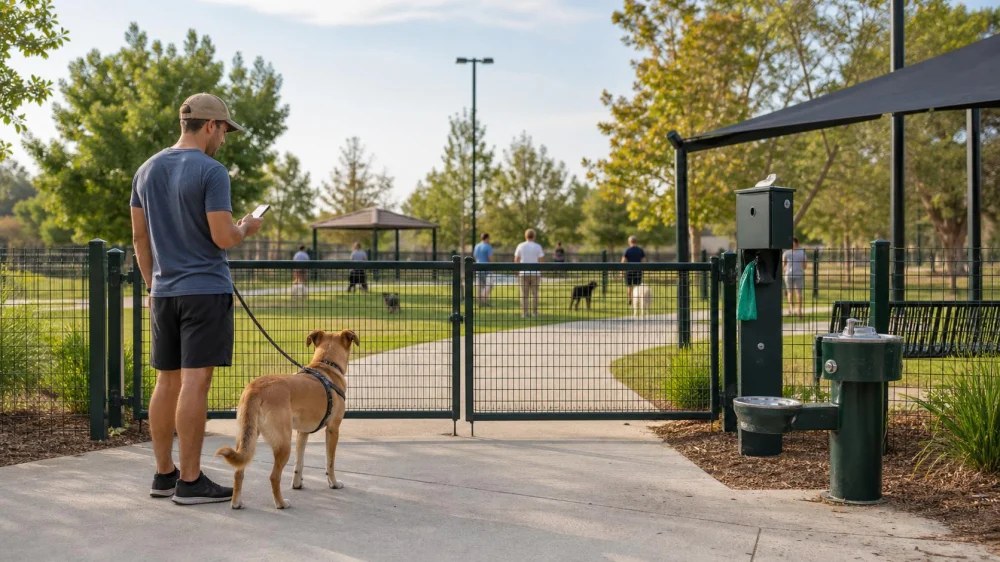
Pause outside the gate and evaluate the physical space. A double-gate entry lets one gate close before the next opens. Check for gaps under fencing, damaged latches, sharp debris, standing water, mud, exposed wire, and crowded pinch points.
Separate small- and large-dog areas can help only when their criteria are clear and users follow them. Size alone does not predict play style or comfort. Look for enough room to move away, shaded resting areas, water only if maintained and acceptable for your pet, and a legal place to wait without blocking entry.
Observe how many animals are present and whether handlers are attentive. A quiet off-peak visit may suit a first introduction better than entering a dense, fast-moving group.
Match the visit to your pet
Dog parks are best for dogs that are comfortable around unfamiliar dogs and people, respond to the handler, and can move without needing constant protection. They are not ideal for every pet.
- Choose a quieter alternative for a pet that freezes, hides, repeatedly tries to escape, guards resources, or becomes overwhelmed around groups.
- Postpone the visit when the pet appears ill, has an injury, or has restrictions from a veterinarian.
- Avoid forcing greetings. Give space and do not hold a restrained pet in the center of off-leash traffic.
- Use a private or leashed walk when controlled distance better matches the pet’s current training and comfort.
For questions about health, vaccination, parasites, injury, or suitability after a medical procedure, consult the pet’s veterinarian rather than relying on general park advice.
Use a calm arrival routine
- Walk the exterior briefly and read current signs.
- Observe the group before committing to entry.
- Remove unsafe dangling equipment only when secure inside and when park rules support it.
- Enter the double gate one household at a time; close and latch each gate.
- Move away from the entrance so arrivals are not surrounded.
- Supervise the pet instead of focusing on the phone or conversation.
- Interrupt escalating interactions early and create distance.
- Leave while the experience is still manageable rather than waiting for exhaustion or conflict.
Carry a leash for the entire visit, waste bags even when dispensers exist, water when needed, identification, and a simple exit plan. Do not bring equipment prohibited by the park.
Park visit checklist
- Exact park and official current rules confirmed
- Hours, closure status, fees, and entry requirements checked
- Leash and designated-area boundaries understood
- Fencing, gates, surface, shade, and crowd observed
- Pet’s comfort and current condition suitable for the visit
- Leash, waste bags, water plan, identification, and transport ready
- Handler prepared to supervise and leave promptly
- Quieter walking or private-space alternative identified
Limitations and important notes
- No fence, rule, or separate area removes all risk of escape, conflict, injury, or illness.
- Shared water bowls, toys, and surfaces may not be appropriate for every pet; ask a veterinarian about individual health concerns.
- Do not enter when a gate is damaged, traffic is uncontrolled, or the environment feels unsafe.
- Children require close supervision and must follow the park’s age and access rules.
- Report damaged facilities or serious incidents through the responsible operator’s process.
Frequently asked questions
Does pet-friendly mean off-leash?
No. It means specified pets are permitted under the property’s rules. Off-leash use is allowed only in clearly designated areas where current rules permit it.
Should I bring toys or treats?
Check the rules and consider how animals may react around valued items. Many parks restrict food, and shared toys can create conflict. A first visit is often simpler without them.
When is a park too crowded?
There is no universal number. Leave when the pet cannot create distance, the gate area stays congested, handlers cannot supervise effectively, or interactions are becoming difficult to manage.
Can puppies use a dog park?
Age, vaccination, and entry rules vary, and a puppy’s health and development are individual. Confirm park requirements and ask the puppy’s veterinarian when the timing is uncertain.
What if another dog worries me?
Create distance and leave calmly. Do not confront another animal. Address rule concerns with the handler only when safe, or use the operator’s reporting process.
Sources and evidence notes
This guide reflects common park-management and pet-handling practice: verify posted rules, control gates, supervise actively, avoid forcing interactions, remove waste, and leave when conditions exceed the handler’s or pet’s comfort. Exact legal requirements and health guidance come from the park operator, local authority, and the pet’s veterinarian.
Plan the visit
Shortlist a nearby park, verify its official rules, and visit the entrance without pressure to enter. Check the gate, crowd, surface, shade, and boundaries. If the space matches your pet and the current conditions, begin with a short supervised visit and keep the quieter alternative available.






 VCA Colonial Animal Hospital4.0 (186 reviews)
 Hilliard Veterinary Hospital4.0 (155 reviews)
 Pleasant Valley Pet Clinic4.0 (296 reviews)
 Animal Emergency & Surgical Center3.0 (835 reviews)
 Furry Friends Veterinary Center4.0 (178 reviews)
 Vetco Vaccination Clinic5.0 (1 reviews)
 How to Spot and Prevent Pet Obesity – Tips for Healthy Weight Management
 How to Choose the Right Pet Insurance Plan for Your Pet's Needs and Budget
 The Ultimate Guide to Pet Safety: Protecting Your Pet Every Day
 How to Make Mealtime Fun for Picky Dogs | Tips and Ideas
 Understanding Pet Emergencies: What to Do
 The Complete Vaccination Schedule for Puppies and Kittens in the USA