
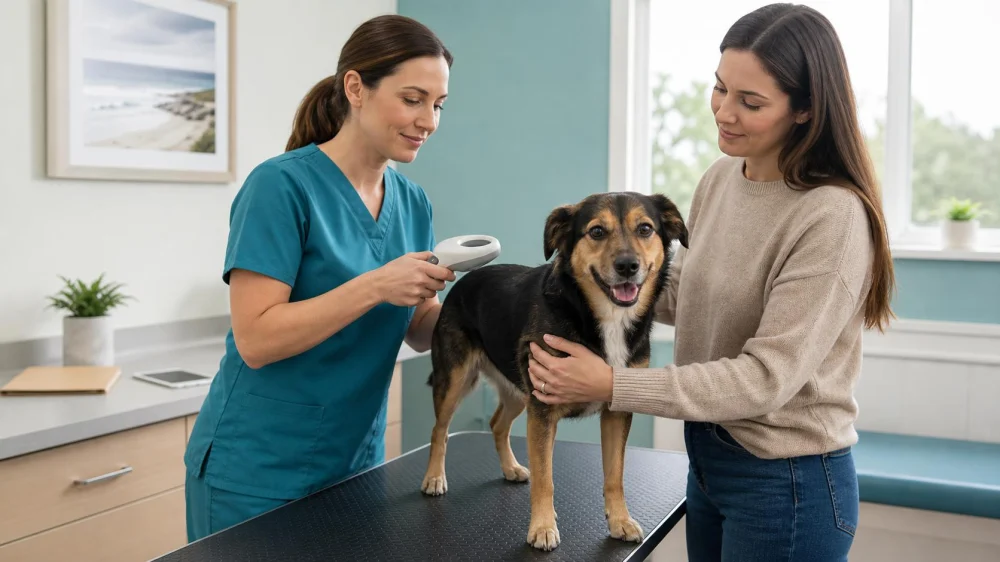
Pet Microchip Records: Verify Registration Before It Matters
On this page
Quick answer
A pet microchip helps only when the chip can be scanned, its identification number leads to a functioning registry, and that registry has current contact information. Ask a veterinary clinic to scan the pet, write down the full number, use the AAHA lookup tool to identify participating registries, and update the actual registry—not the lookup tool.
A microchip is not GPS and does not replace a collar tag, secure home, leash, carrier, or current photo. For international travel, the destination may impose separate rules about chip standard, timing, vaccination, and documents; verify those with USDA APHIS and a USDA-accredited veterinarian.
Know what a microchip does
A pet microchip contains a unique identification number. A compatible scanner energizes and reads the chip; a shelter or veterinary team can then use registry information to help contact the person associated with that number. Owner details are maintained by a registry, not stored as a complete profile inside the chip.
Identification, not live location
The chip has no GPS tracking function. It cannot show a pet moving on a map, send an escape alert, or report a battery level. A separate GPS or radio tracker may offer location features, but it has its own fit, charging, coverage, subscription, and safety considerations.
Implantation and registration are different steps
A veterinarian or clinic may implant a chip, but the owner may still need to activate or complete registration. Ask who submitted the initial record, which registry holds it, whether ownership is confirmed, and what action remains. A chip with no reachable record cannot perform its recovery role as intended.
The veterinarian is not necessarily the registry
Your clinic may keep the number in the medical record, but address and phone changes in that record may not update the external recovery registry. Confirm both systems separately.
Verify the number and registry
Step 1: have the pet scanned
Ask your veterinarian to scan the pet during a routine visit and provide the complete number exactly as read. AAHA encourages annual scanning to confirm that a chip can be detected and identify its location. Do not rely only on old adoption paperwork or a typed number.
Step 2: compare every record
Check the scanned number against:
- the veterinary medical record;
- adoption, breeder, or transfer paperwork;
- the registry account;
- insurance or licensing records that include the chip;
- travel certificates or vaccination records when applicable.
If one digit differs, stop and resolve it. Do not guess which version is correct. Ask the veterinary team to rescan and document the number.
Step 3: identify the registry
Enter the chip number without spaces or punctuation in the AAHA Microchip Registry Lookup. It may return one or more participating registries or a manufacturer/distributor lead.
The AAHA tool does not display owner details, maintain the registry, or update an account. Contact the listed registry directly, starting with the most recently updated result. If the search fails, try later and ask the clinic or implanting organization for trackback information.
Step 4: verify control of the record
Sign in through the registry’s official website or contact its verified support channel. Confirm that you are authorized to manage the record. Avoid entering personal information through an unsolicited text, email, advertisement, or look-alike website.
Update the recovery record
Exact fields vary, but a useful registry record commonly includes:
- primary owner name and current phone number;
- a second phone number and monitored email address;
- current home or mailing address when requested;
- an alternate contact who has agreed to respond;
- veterinary clinic contact information;
- pet name, species, sex, breed or type, color, and distinguishing features;
- relevant recovery notes allowed by the registry.
Use reachable contacts
Choose numbers that can receive calls from unfamiliar callers and voicemail. Confirm the alternate contact understands the role and has a current photo and your travel contact. Remove a former partner, old employer, disconnected number, or deceased contact promptly.
Confirm, do not assume
After saving changes, review the record again and keep the registry’s confirmation. Some services distinguish free registration, paid upgrades, monitoring, or optional subscriptions. Read what is required to keep the core contact record active; do not assume a marketing add-on is mandatory.
Protect privacy
Use a unique password and multifactor authentication when offered. Do not publish the full chip number in a public lost-pet post unless a legitimate recovery organization specifically needs it through a secure channel. The number can help prove or manage a record.
Use life-event checkpoints
Review the registry whenever any of these occur:
- adoption, purchase, rescue transfer, or change of legal owner;
- move, temporary relocation, evacuation, or extended travel;
- new phone number, email address, veterinarian, or alternate contact;
- name change or change in household caregivers;
- pet loss, recovery, or a report that contact attempts failed;
- registry merger, closure, service warning, or repeated lookup failure;
- international travel planning.
Add an annual calendar reminder tied to a memorable month, such as the pet’s adoption anniversary. At the same time, ask for a scan, inspect the collar tag, update photos, and confirm the carrier and leash.
When adopting an already chipped pet
Obtain the chip number and transfer instructions in writing. The shelter, rescue, breeder, prior owner, or registry may need to authorize ownership transfer. Complete the process and confirm the final account rather than relying on a verbal promise.
When a registry closes or is unavailable
Ask your veterinarian to scan the chip and use AAHA’s current lookup information. The existing implant may not need replacement; re-registration with a functioning service may be possible. Get model- and situation-specific advice before implanting another chip, and ensure every active number is documented if more than one exists.
Keep travel requirements separate
A recovery registry and an international health certificate serve different purposes. Destination countries may require a specific microchip standard, a readable chip, implantation before certain vaccinations, exact number transcription, or a compatible reader. Rules can change and may differ by species and itinerary.
- Start at the current USDA APHIS Pet Travel site.
- Select the correct destination, species, origin, transit points, and return plan.
- Contact a USDA-accredited veterinarian as early as possible.
- Have the chip scanned and match the number to every vaccine, test, and certificate.
- Confirm airline, destination, transit-country, and U.S. return requirements separately.
Do not assume a 15-digit number automatically satisfies every rule, or that a chip accepted for recovery is accepted for travel. Do not implant a second chip or repeat vaccination on the basis of a general article; use destination-specific veterinary guidance.
If your pet is missing
Act immediately. Notify the registry using its verified contact method and confirm that the record is current. Contact local shelters, animal control, veterinary hospitals, and the adoption organization. Search the immediate area safely, tell neighbors, and use clear recent photos.
Keep the primary phone available, check spam and voicemail, and warn alternate contacts. Be alert for scams: a legitimate finder or shelter may ask for identifying information, but avoid sending money, one-time security codes, banking details, or account passwords.
If you find a pet
Prioritize safe handling and follow local lost-animal procedures. A veterinary clinic, shelter, or animal-control agency may scan the pet. The AAHA lookup identifies potential registries; it does not reveal owner information. Let an authorized registry or agency handle contact and privacy.
Limitations and safety notes
Microchips are not fail-safe. Scanner compatibility, scan technique, registry participation, record accuracy, and organizational availability can affect recovery. Use layered identification: a readable collar tag when safe, a secure environment, current photos, and a verified microchip record.
Implantation and scanning are veterinary procedures. Ask a veterinarian about pain, swelling, discharge, a new lump near the implant area, concern about migration, or whether a chip should be replaced or supplemented. Do not try to locate or manipulate it yourself.
This article is general U.S. educational information. Ownership disputes, privacy, licensing, import, export, and quarantine requirements may need legal, veterinary, or government guidance.
Frequently asked questions
Can a microchip show where my pet is?
No. A standard pet microchip is an identification device, not GPS. It must be scanned, and its number must connect to a registry record with reachable contacts.
Does updating my veterinarian update the chip registry?
Not necessarily. The clinic’s medical record and the external recovery registry are separate systems. Update both and confirm the registry directly.
Where do I update a microchip?
Update it with the registry that maintains the record. AAHA’s lookup tool can identify participating registries, but AAHA does not hold or edit owner information.
What if I do not know the microchip number?
Ask a veterinary clinic or shelter to scan the pet and give you the full number. Compare it with existing records before contacting registries.
Should I register the same chip with more than one service?
Practices and fees vary. First ensure at least one reliable, discoverable registry has an accurate record. If considering multiple services, understand how updates, ownership, and lookup results will be maintained consistently.
Is a microchip enough for international travel?
No. The destination may require a particular chip standard and timing plus vaccinations, tests, certificates, endorsements, or other steps. Use current USDA APHIS guidance and a USDA-accredited veterinarian.
Sources and evidence notes
- American Animal Hospital Association: Pet microchipping FAQs explains scanning, identification numbers, registration, contact updates, GPS misconceptions, and ownership transfer.
- AAHA animal identification statement encourages reliable registries, current owner information, annual scanning, and collar identification.
- USDA APHIS Pet Travel Process Overview explains that destination countries set requirements that may include microchips, vaccinations, tests, and health certificates.
Registry status and travel rules can change. The linked current tools and destination pages control over examples or old paperwork.
Next steps
Schedule or request a chip scan, copy the full number into your records, locate the registry through AAHA, and confirm two reachable contacts. Then set an annual reminder to rescan, review the registry, inspect the collar tag, and update the pet’s photo.




 Vetco Vaccination Clinic4.0 (8 reviews)
 Vetco Vaccination Clinic2.0 (5 reviews)
 Becker Veterinary Clinic4.0 (176 reviews)
 Suburban Animal Hospital4.0 (475 reviews)
 Essentails Ecom0.0 (0 reviews)
 Fur and Feathers Veterinary Care4.0 (317 reviews)
 How to Help Your Pet Stay Comfortable During Hot Weather
 Is Your Pet Insurance Coverage on Track?
 How to Spot and Treat Canine Hip Dysplasia: A Comprehensive Guide
 How to Recognize Signs of Heartworm in Dogs and Protect Them
 Top 11 Tips Every Owner Should Know for Optimal Pet Health
 How to Socialize Your Cat Without Stress: A Guide to Cat Socialization