
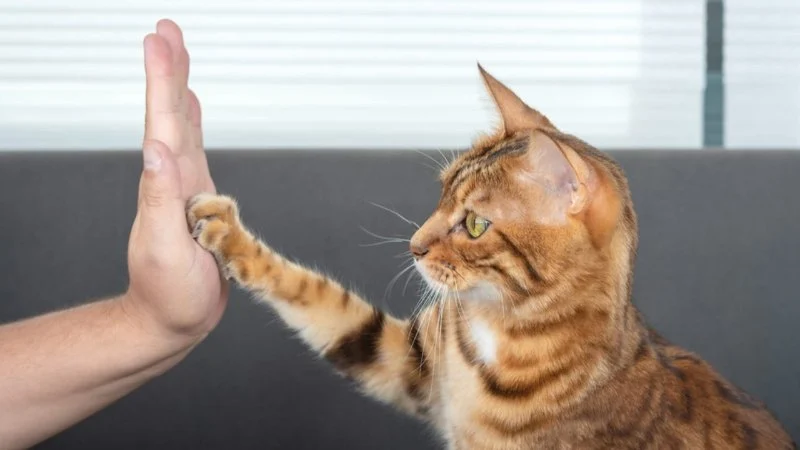
Why Cats Use Paw Tapping as a Form of Communication
- feline-body-language - understanding how cats “speak” without words
- attention-signals - why your cat insists on physical interaction
- play-behavior - how paw taps can signal invitation to engage
- bonding-expression - signs of trust and affection through touch
If you’ve ever been sitting on the couch and suddenly felt a soft tap on your arm or face, you’re not alone. Many cat owners ask the same question: why does my cat tap me with paw? This small but intentional gesture is one of the most fascinating parts of feline communication.
Unlike dogs, cats don’t rely heavily on vocal communication. Instead, they use subtle body language—tail movement, ear positioning, eye contact, and yes, paw tapping—to express needs, emotions, and curiosity. What may feel like a random touch is often a carefully chosen signal.
The Most Common Meaning: “I Want Your Attention”
One of the most frequent explanations behind cat paw tapping is simple: attention-seeking behavior. Your cat may be telling you that it wants food, petting, playtime, or just acknowledgment.
In many households, cats quickly learn that a gentle tap gets a response faster than meowing. This creates a learned behavior loop where the cat uses paw contact as an efficient communication tool.
When observing cat attention behavior, context matters. If your cat taps you in the morning near feeding time, it may be a reminder that breakfast is expected. If it happens during your work or screen time, it might be a request to shift focus back to them.
Paw Tapping as a Play Invitation
Not all taps are about food or attention. In many cases, paw tapping is a direct invitation to play. Cats are natural hunters, and their play behavior often mirrors stalking, pouncing, and light physical engagement.
If your cat gently taps your hand and then retreats or crouches slightly, it may be initiating a playful interaction. This is especially common in younger cats or highly energetic breeds.
Understanding cat play invitation signs can help you respond appropriately. Instead of ignoring the behavior, offering a toy or engaging in interactive play can strengthen your bond and reduce unwanted attention-seeking later.
A Real-Life Example: The “Office Assistant Cat”
A common story shared by remote workers involves a cat that consistently taps its owner during work hours. At first, it seems like disruption, but over time, the pattern becomes clear.
The cat approaches the desk, gently taps the arm, and waits. If ignored, it escalates to a second tap or sits directly in front of the keyboard. Once the owner engages in a short play session, the cat calmly settles nearby.
This behavior reflects a structured communication system. The paw tap is not random—it is a predictable signal that blends affection, curiosity, and routine expectation.
Affection and Emotional Bonding Through Touch
Sometimes the answer to why does my cat tap me with paw has nothing to do with demands at all. Cats often use light touch as a form of social bonding.
In feline groups, gentle physical contact helps reinforce trust. A soft tap on your arm or face can be your cat’s way of saying, “I recognize you as part of my safe circle.”
This form of cat affectionate behavior is especially common in cats that have strong bonds with their owners. It is less about requesting something and more about maintaining connection.
When Paw Tapping Becomes More Persistent
Some cats escalate their tapping behavior if they feel ignored. This does not necessarily mean aggression—it often reflects persistence in communication.
If your cat repeatedly taps you, it may be trying to increase urgency. For example, a cat that wants food or access to a closed room may continue tapping until the message is acknowledged.
Understanding feline communication body language helps distinguish between playful taps and urgent requests. Watching for accompanying signals—like vocalization, pacing, or staring—can clarify intent.
How Environment Influences Paw Tapping Behavior
A cat’s environment plays a major role in how often and why it taps its owner. Boredom, lack of stimulation, or inconsistent routines can increase attention-seeking behaviors.
Cats living in enriched environments with toys, climbing spaces, and predictable schedules tend to use paw tapping more selectively—often for affection rather than necessity.
In contrast, under-stimulated cats may tap more frequently as a way to initiate interaction or relieve boredom.
Misinterpretations Owners Often Make
One common mistake is assuming paw tapping is always a demand. While it can be request-driven, it is often layered with emotional meaning.
Another misunderstanding is reacting only when the behavior becomes annoying. This can unintentionally reinforce excessive tapping if the cat learns that persistence is required for attention.
Balanced responses—acknowledging the cat but setting boundaries—help create healthier communication patterns.
A Small Behavior With Big Emotional Meaning
What seems like a simple tap often reflects a complex emotional and behavioral system. Cats learn from interaction patterns, emotional feedback, and environmental consistency.
When owners begin observing closely, they often realize that paw tapping is part of a larger dialogue. It is not random—it is intentional communication shaped by trust and routine.
Many cat owners who explore deeper behavior insights through trusted resources like Brothers Pets discover that small gestures often reveal the strongest bonds.
Building a Better Response to Paw Tapping
Responding effectively does not mean giving in every time. Instead, it involves recognizing context and responding in a way that supports both emotional connection and behavioral balance.
If your cat taps for play, a short interactive session can be enough. If it taps for attention, a brief acknowledgment may satisfy the need. Over time, this builds clearer communication between you and your pet.
Understanding these signals helps transform what might seem like a quirky habit into a meaningful part of your relationship with your cat.




 Hope Springs Veterinary at Pembroke4.0 (300 reviews)
 Teacup Pomeranian puppies Florida5.0 (7 reviews)
 Bassler Veterinary Hospital4.0 (36 reviews)
 VCA Met Vet West Animal Hospital4.0 (424 reviews)
 Winfield Veterinary Hospital3.0 (45 reviews)
 Banfield Pet Hospital4.0 (138 reviews)
 How to Care for Your Pet's Eyes and Ears
 How to Spot and Treat Hip Dysplasia in Dogs: A Complete Guide
 Common Mistakes in Parasite Prevention and How to Avoid Them
 How to Spot and Treat Pet Anxiety and Stress
 How to Prevent and Treat Pet Allergies to Food and Environment
 How to Help Your Pet Adjust to Life After Losing a Companion